Numbers - Part I: Natural and Rational Numbers

Watch the content of this blog post in the form of a video
The world in which we live has qualitative, structural and quantitative aspects. If we abstract its quantitative and structural aspects and ignore the qualitative aspect, then we are left with a conceptual realm with its own logical rules, to whose study the discipline of Mathematics is devoted. The concept of numbers lies at the heart of our understanding of the quantitative aspect of reality. In this and the next post, I will attempt to explore this concept. The discussion will be somewhat informal, deviating from strict mathematical formalism, because the edifice of Mathematics, while on one hand is rooted in reality and its components, reflecting the fundamental structures and patterns of the actual natural world, on the other hand is also a construct of human intellect and creativity, shaped according to specific rules and preferences devised by humans. Here, we want to focus on the underlying reality that Mathematics strives to describe, and not so much on the man-made layers built on top of that, however useful they may be. It is true, however, that the natural and man-made are intertwined and are difficult, and in many cases impossible, to separate - especially if one considers that our understanding of reality necessarily passes through our cognitive faculties, and is therefore, to some degree, subjective.
Natural Numbers
In ancient Greece, Mathematics was expressed mostly in a language whose basic elements were geometric entities, like points and lines, whereas in modern Mathematics the basic elements are the natural numbers. Indeed, the natural numbers, 1, 2, 3, etc. seem to be quite fundamental concepts of the reality in which we exist. For example, if we consider:
- 3 persons, or
- 3 apples, or
- 3 phones, or
- 3 galaxies, or
- 3 fairy tales, or
- 3 historical events, or
- 3 days, or
- 3 games, or
- 3 geometric figures
then while qualitatively very different, what they all share in common is their numerosity; the abstract concept that they share we call the number 3.
Now, the world appears to consist of things that are either discrete or continuous. Some of the things mentioned previously are discrete only at the conceptual level, e.g. apples, galaxies or phones, since they consist of more fundamental constituents (molecules, stars, wires, screws and electronic circuits - which may themselves consist of even more fundamental constituents) but for various reasons, such as their function and utility to us, we conceptually regard them as single entities. Other things mentioned, such as games and geometric figures, are not even material things but concepts entirely. Nevertheless, the world does include things of a discrete nature that exist objectively; for example, physics, and quantum mechanics in particular, tells us that at the most fundamental level the physical world is discrete, with matter consisting of fundamental particles that cannot be subdivided. But, even more fundamentally in my opinion, persons, or selves, such as you and me, are indivisible monads (which is something that we can discuss in a future series of blog posts about the philosophy of mind).
The natural numbers arise naturally when we consider the numerosity of discrete things, such as those mentioned in the previous examples. Leopold Kronecker (1823–1891) has famously said that:
Natural numbers were created by God, everything else is the work of men.
In my opinion, while it can indeed be argued that natural numbers are the most fundamental kind, the above statement is not entirely true; natural numbers do not suffice to describe everything, because not everything is discrete.
Rational Numbers
So, how about things that we perceive as continuous (at least from a macroscopic point of view), such as length, time, speed, size, mass, force, or intensity (of light, sound etc.)? Even some of the discrete things that we mentioned previously can be thought of as having fractional parts. For example, we can think of half an apple, or a quarter of an apple.

For continuously-varying quantities, does it make more sense to use, like the ancient Greeks, geometry rather than algebra? After all, length can be used as a prototypical continuous quantity that can be used in figures to represent any other continuously-varying quantity, whereas the natural numbers seem ill-suited for this. However, the example of splitting an apple into two parts gives us an idea of how to use the natural numbers to express fractional parts: We can split something into an integer number of equal parts, and take some of them; this splitting operation can again be abstracted from the type of thing split, resulting in the concept of a rational number (so called because it expresses a ratio, or fraction). For example, taking half of something is conceptualised by the rational number symbolised as 1/2, and splitting something into 3 equal parts and taking 2 of them is conceptualised as the rational number 2/3.
In fact, it turns out that the process of taking a whole, splitting it into 3 parts, and taking 2 of them, is equivalent to taking 2 wholes and splitting them into 3 equal parts.
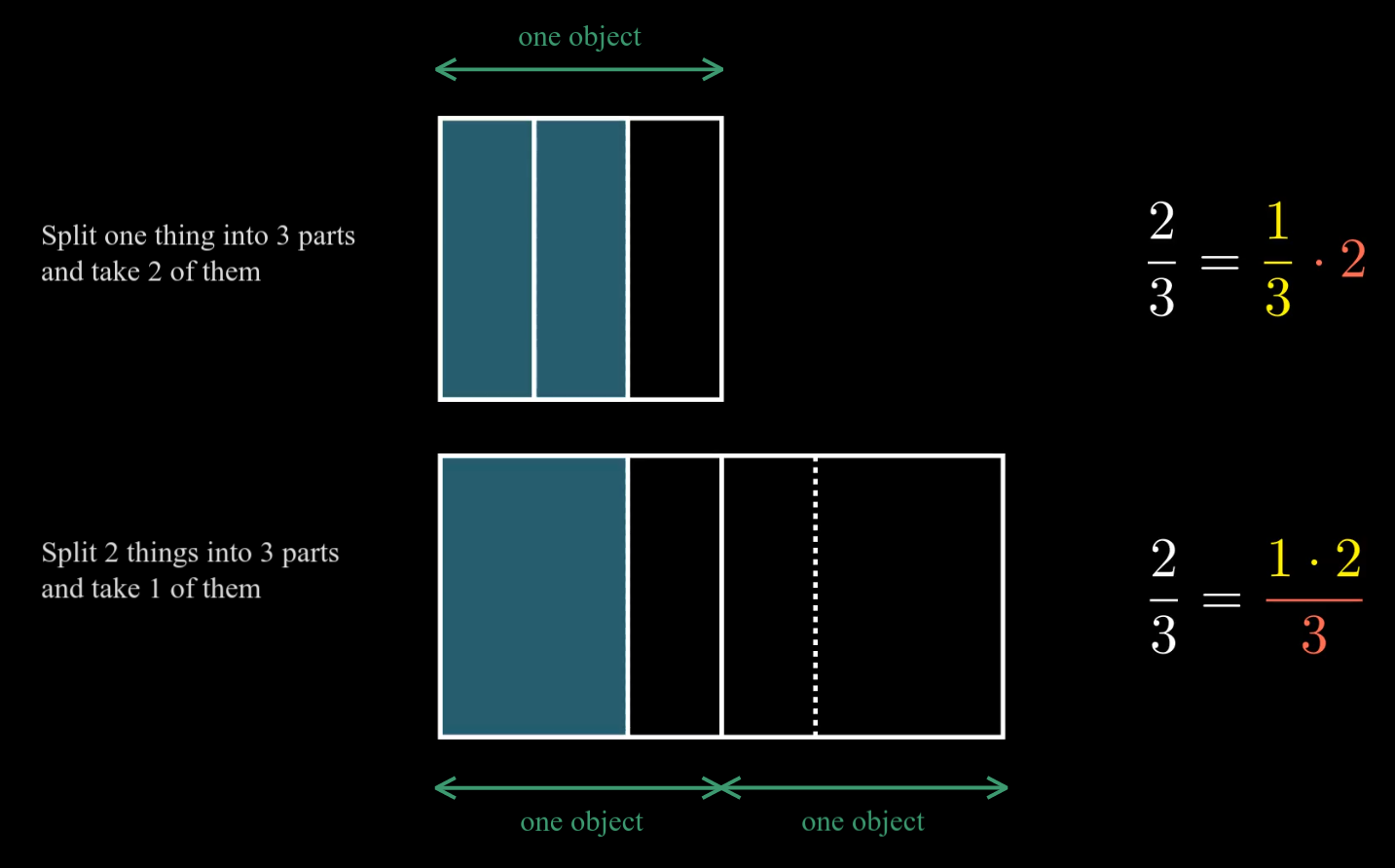
Therefore, the rational number
\[\frac{m}{n}\]
can be interpreted as the outcome of splitting a whole into n equal parts and taking m of them, or, equivalently, as the outcome of taking m wholes, splitting their aggregate into n equal parts, and taking one of them. To keep things simple, we mostly adopt the first interpretation here, although both interpretations are equivalent.
Note that the numerator m can be greater than the denominator, in which case the number of parts that we have, together, make more than a whole. For example, 5/2 apples are 5 halves, which makes 2 whole apples plus half an apple.
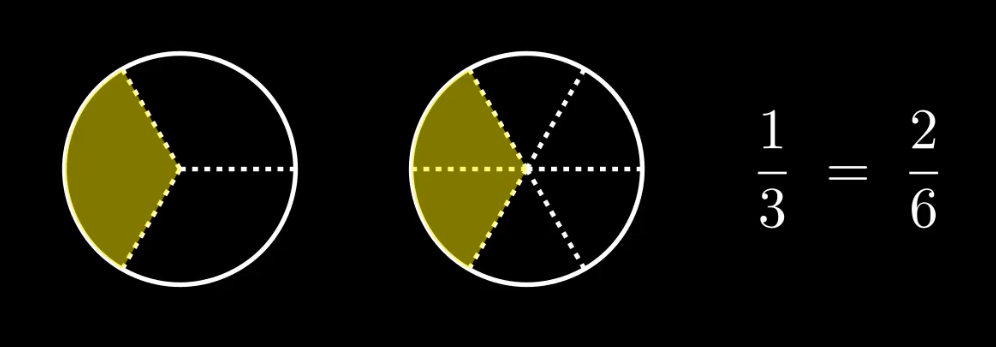
There is a subtle point that should be pointed out: the abstract process of splitting something into n equal parts and taking m of them is not one and the same as the rational number m/n; rather, the number m/n is an abstraction of the result of that process. It is the quantity, relative to a whole, that we will get via that process. In fact, we can get the same quantity through different processes. Whether I cut an apple into three parts and take one, or I cut it into 6 and take 2, I end up with the same quantity of apple. These two processes are not entirely the same, yet they produce the same result, and hence the numbers 1/3 and 2/6 are considered to be the same number. In general,
$$ \begin{equation} \label{eq: equivalent fractions} \frac{m}{n} \;=\; \frac{m\cdot c}{n\cdot c} \end{equation} $$where c is an arbitrary number, and a rational number can be written as infinitely many equivalent fractions.
So, the concept of rational number is based on the concept of natural number, but allows us to quantify things that are not necessarily discrete. Whereas natural numbers only count wholes, rational numbers can also count parts of wholes. They do so through a mechanism that is based on the concept of natural numbers themselves, by defining sub-wholes of the form 1/n: one among n equal parts of a whole.
Because rational numbers are based on the concept of natural numbers, they are inherently based on the concept of a whole, on which natural numbers are also based. 3/4 of something means 3/4 of a whole, with the latter corresponding to the number 1. But what about quantities that vary continuously without an inherent sense of "whole", such as distance or time? 3/4 of an apple makes sense, but does 3/4 of time make sense? No; but in such cases we can ourselves choose an arbitrary chunk of time and consider it as a "whole", as a unit of time – e.g. a day or a year. Quantification of continuous magnitudes cannot be made in an absolute sense; only comparison of one quantity to another makes sense, when there is no natural unit. A description of a quantity of some continuous stuff such as time or distance by rational numbers makes sense only in a relative sense, as compared to another chosen quantity of the same stuff.
Representational Contraptions
To explore the mechanics of numbers, it is useful to use some representational contraption; for example, the natural number a can be represented by a box containing a dots. Then the concept of the addition a+b can be visualised as merging the a and b dots into a single box, and the multiplication a×b can be visualised as stacking a rows of b dots into a single box.
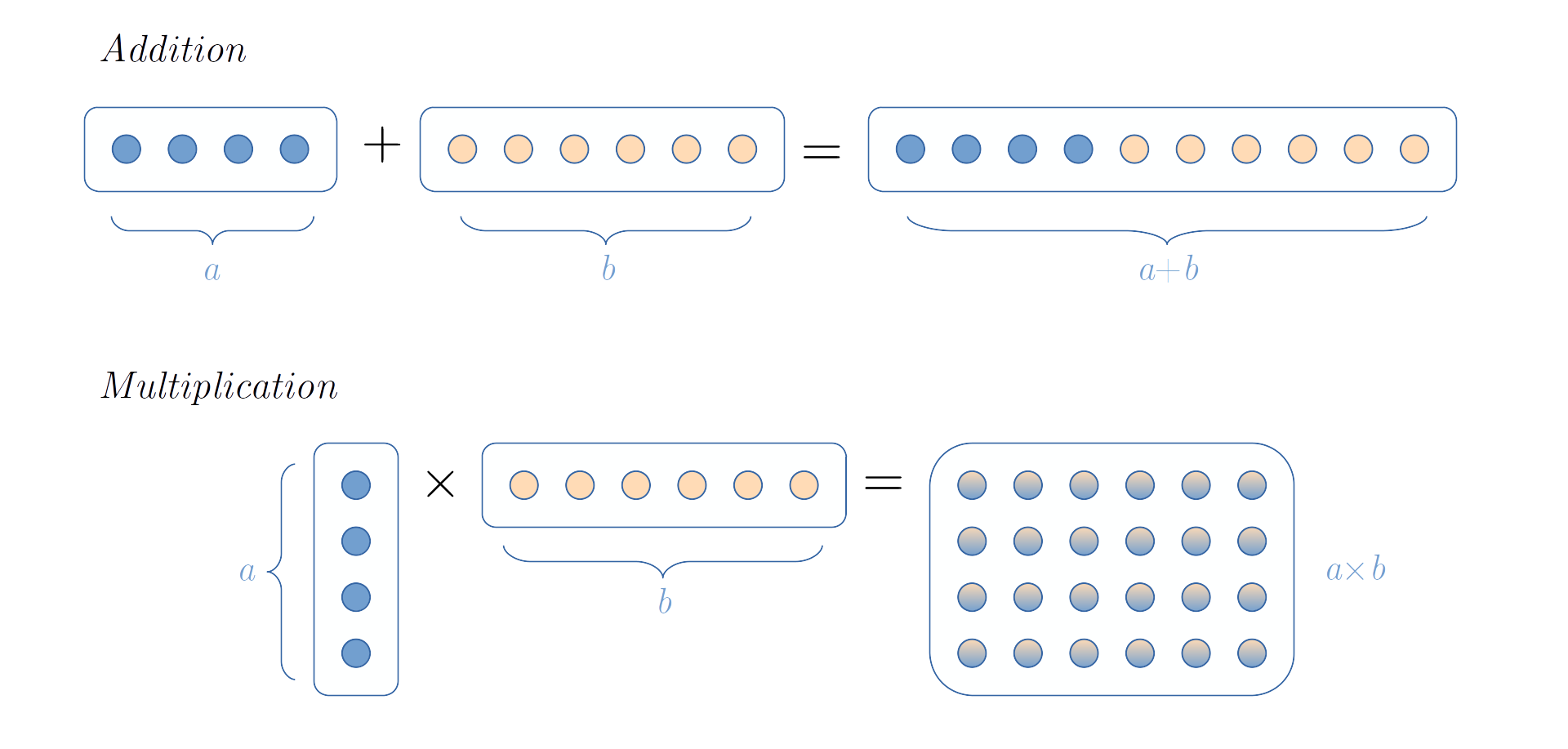
Such a representation aids us to see in an obvious manner the validity of several truths about the mechanics of the arithmetic of integers. For example, the Distributive Law, c(a+b) = ca + cb, can be illustrated as
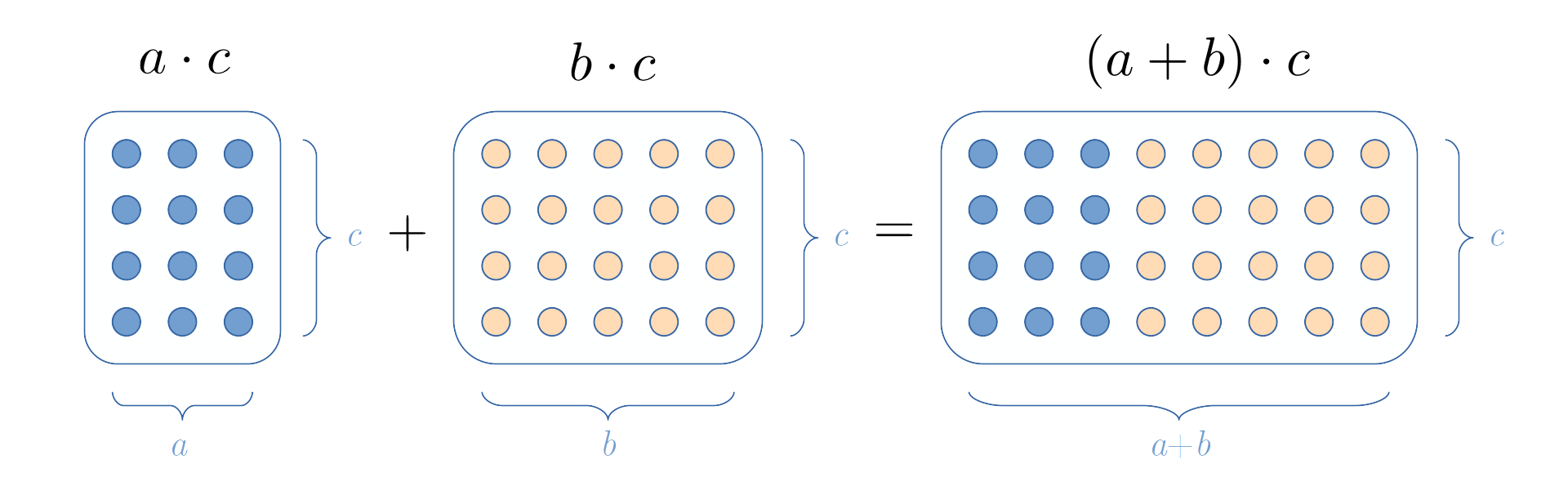
The conclusions we draw from observing these illustrations have general validity, provided that they do not depend in any way on the nature of the representational elements we chose. In our example we chose dots to represent instances of something, but our choice of dots makes no difference to the conclusion; we could have used apples, persons, games, galaxies or whatever else we wanted, because the nature of the things used is irrelevant to the substance of the logical arguments made, in line with the abstractive nature of Mathematics.
Just like dots are convenient for illustrating the mechanics of the arithmetic of discrete things, for continuous quantities it is very convenient to use length as a prototypical quantity for representational purposes. In this case, as mentioned, we must also assume that a "unit" quantity has also been selected, so that the quantification of all other quantities is understood to be in comparison to this selected unit. Then, how numbers measure a continuous quantity can be illustrated by drawing a straight line and marking numbers on it, using length as a prototype that represents any continuous quantity. This line is called the "number axis", and the number that corresponds to each point on the line is an abstraction of the size relation between the length of the segment from 0 to that point compared to that of the unit segment [0,1].
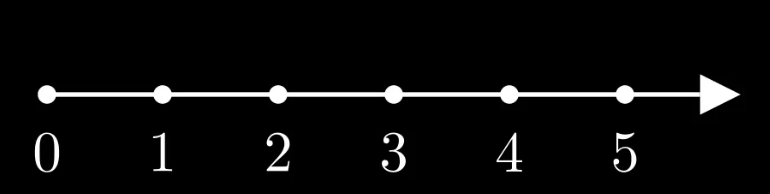
On this axis we have marked the integer numbers 1, 2, etc. which correspond to one, two, etc. of our selected units. The start of the axis is zero, which denotes the case that the continuous quantity is completely lacking. Often-times it makes sense to extend the axis in the opposite direction, where numbers are marked with a negative sign. For example, if the continuous quantity is the distance travelled along a line starting from a given point inside that line, then one can transverse it in either direction, and the sign can indicate the direction. There are also cases where the placement of "zero" seems arbitrary, such as in the quantification of temperature (before it was discovered that there is an absolute zero), where for example in the Celsius scale zero was arbitrarily placed at the temperature where water freezes, and any temperatures colder than that are assigned negative values. There are also cases where two opposite states compete with each other, such as positive and negative charge, or credit and debt in finance, where the sign of the numbers indicates the prevailing state. In these and other cases the concept of a negative number makes sense and is useful, and we can account for it in our illustrative model by extending our line in the opposite direction from zero to infinity, marking on it the negative integers.

How about fractional parts? We can mark any rational number we desire on the axis by splitting each unit of the axis into 1, 2, 3, … etc. equal parts – as many as we wish, and taking, again, as many as we wish from them. If we split them into two, we get the numbers 1/2, 2/2, 3/2, …
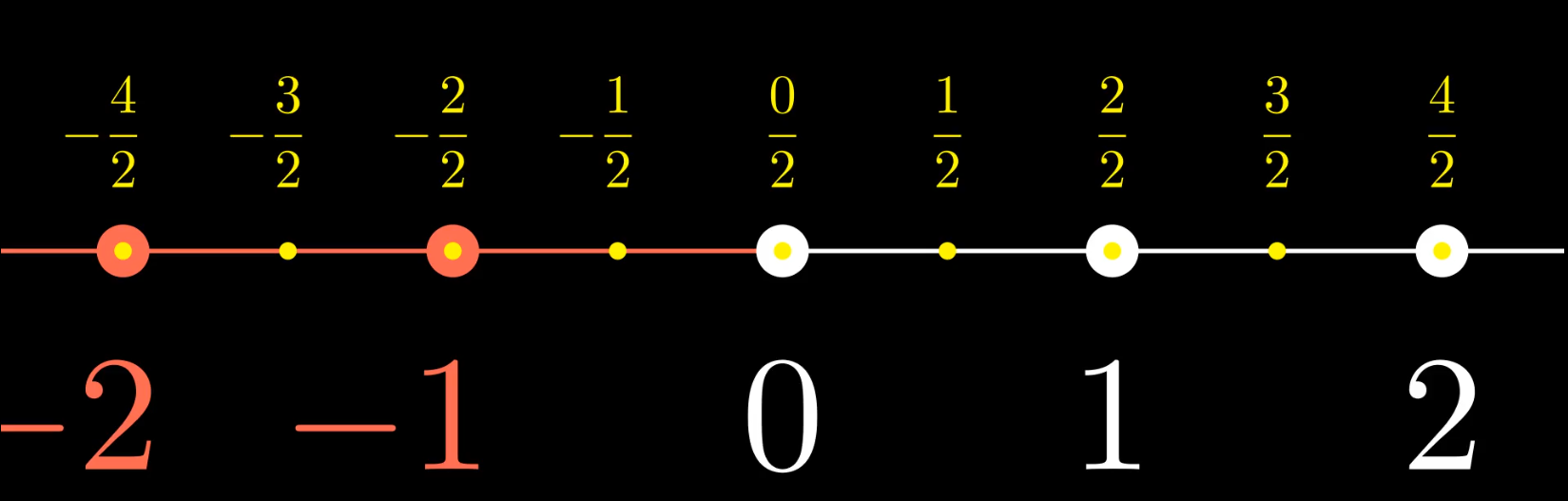
If we split them into 3, we get the numbers 1/3, 2/3, 3/3, 4/3 etc. And so on.
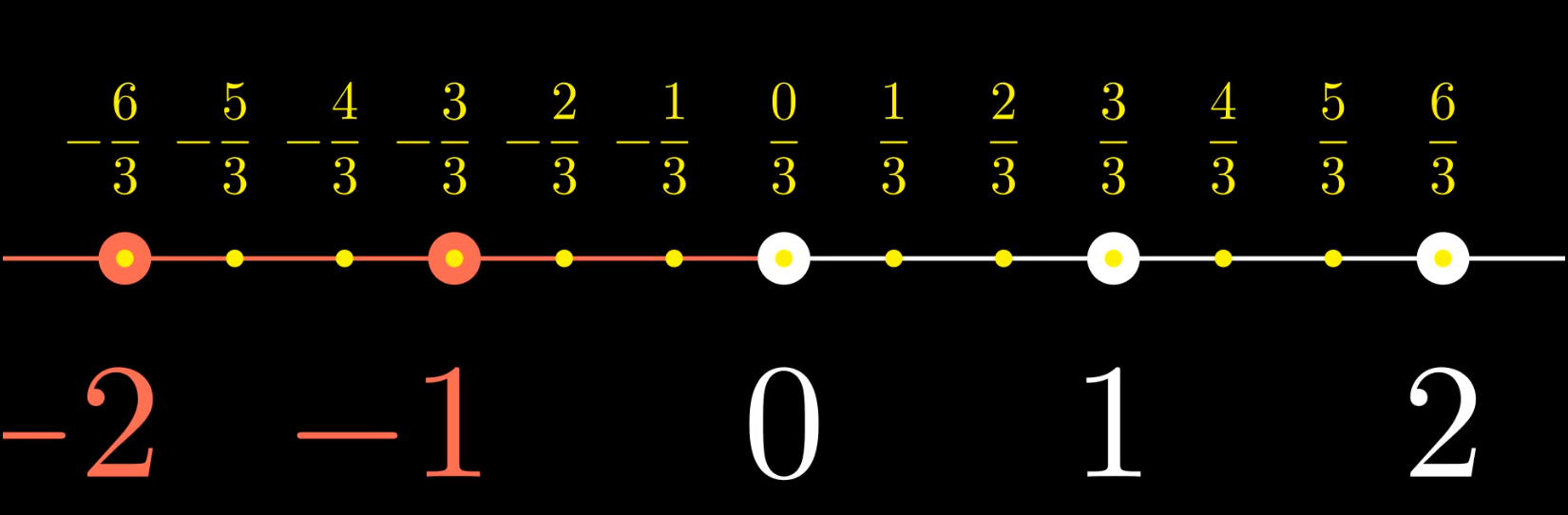
This procedure can be continued to infinity, so that every number of the form m/n (rational number) will eventually be marked on the line. The points become denser and denser as we increase the denominator n (the number of parts that each unit is split into).
Operations on Rational Numbers
Apart from the concept of a number itself, it makes sense to consider also manipulations of numbers which are abstractions of actual processes that occur in the real world.
Addition
Addition (and its opposite, subtraction) are perhaps the most basic operations. How to add (or subtract) rational numbers becomes apparent if we express them in terms of the same division of unity, by scaling both the numerator and denominator of each number by the denominator of the other number:
$$ \begin{equation} \label{eq: rational addition} \frac{a}{b} \;+\; \frac{c}{d} \;=\; \frac{ad}{bd} \;+\; \frac{cb}{db} \;=\; \frac{ad \,+\, cb}{bd} \end{equation} $$The above operation became straightforward by expressing both numbers as multiples of the same quantity, 1/bd (the reciprocal of the product of denominators).
$$ \begin{equation} \label{eq: rational addition 2} \left. \begin{array}{l} \dfrac{a}{b} \;=\; ad \cdot \dfrac{1}{bd}\\[0.4cm] \dfrac{c}{d} \;=\; cb \cdot \dfrac{1}{bd} \end{array} \right\} \Rightarrow\; \frac{a}{b} \;+\; \frac{c}{d} \;=\; \left(ad \;+\; cb\right) \frac{1}{bd} \end{equation} $$The possibility of expressing both numbers as integer multiples of the same sub-unit, namely 1/bd in this case, is called commensurability, and the numbers a/b and c/d are characterised as commensurable. The number 1/bd is their common measure; it is a number that can fit an integer number of times into both numbers. Actually, commensurable numbers have infinitely many common measures (e.g. 1/(2bd), 1/(3bd) etc. are also common measures of a/b and c/d).
Since a/b and c/d are arbitrary rational numbers, this means that all rational numbers (expressing fractions of the same underlying unit) are commensurable with each other. And, of course, foremost of all, all rational numbers are commensurable with the unity of which they express a fraction: a/b = a·(1/b) where 1/b is a subdivision of the unit.
Subtraction
Subtraction is the opposite of addition, it undoes what addition does, and means removal. In the case of quantities that can assume both positive and negative values, subtraction of b from a simply means to start from a (whether positive or negative) and go in the opposite direction of b (whether positive or negative) by an amount equal to the magnitude of b.
Multiplication
Now let us turn to the multiplication of rational numbers. First, let us remind ourselves that the rational number a/b is the result of the process of splitting the unit into b equal parts and taking a of them. The multiplication of another number by a/b is the result of applying the same process on that other number rather than on unity.
So, the multiplication of (c/d) by (a/b) means splitting (c/d) into b equal parts and taking a of them. Let us start with the splitting. (c/d) itself is c subunits of size (1/d) each. To split it into b parts, we can split each of the (1/d)-size subunits into b parts, and sum them:
$$ (c/d) \;/\; b \;=\; c \, ((1/d) \,/\, b) $$If we split each of these subunits into b parts, we will end up with smaller subunits of size 1/(bd). We can see this by considering that 1/d is contained d times in 1, and (1/d)/b is contained b times in 1/d. Therefore, overall, (1/d)/b is contained bd times in 1: (1/d)/b = 1/(bd). And we have c of these subunits, for a total of c/(bd).
This was just the application of the splitting part of a/b to c/d. Now we also have to apply the part that calls for taking a parts. This leaves us with a total of ac subunits of size 1/(bd) each, overall:
$$ \begin{equation} \label{eq: rational multiplication} \frac{c}{d} \cdot \frac{a}{b} \;=\; \frac{ac}{bd} \end{equation} $$From formula ($\ref{eq: rational multiplication}$) it should be apparent that we would have gotten exactly the same result if the roles of the two numbers were reversed, i.e. if we had applied (c/d) to (a/b) instead of applying (a/b) to (c/d) (remember the commutative property of the natural numbers, ac = ca and bd = db). Therefore, the commutative property holds also for rational numbers:
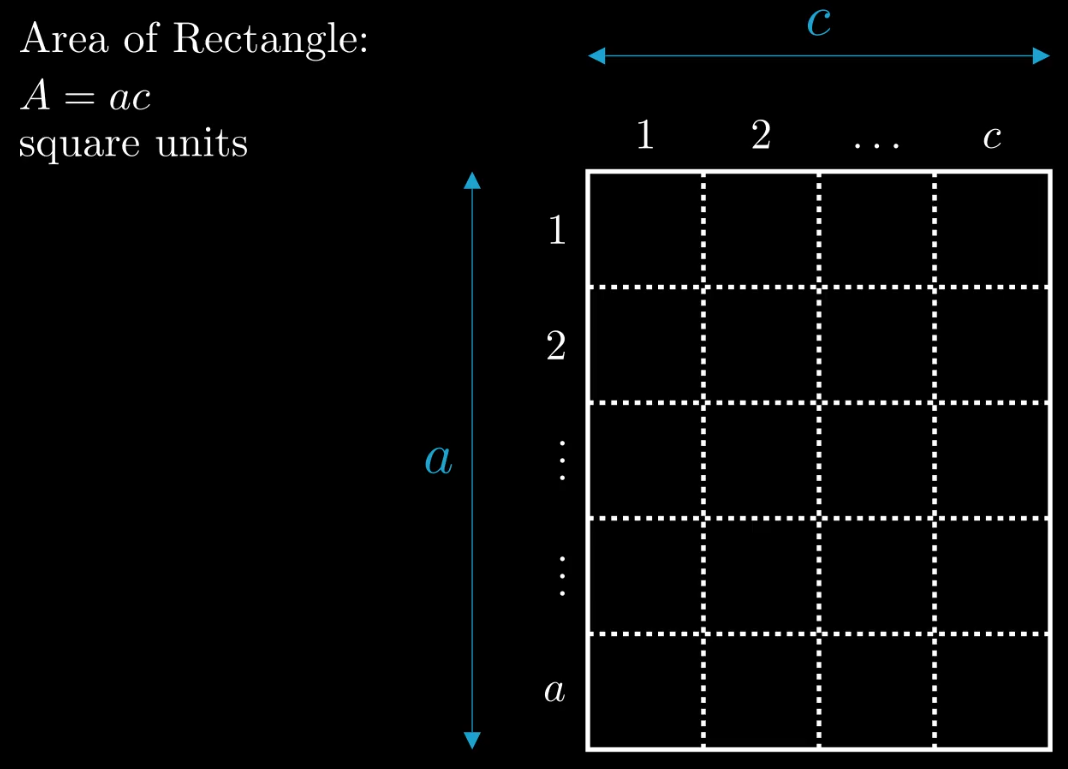
$$ \begin{equation} \label{eq: rational multiplication commutative} \frac{c}{d} \cdot \frac{a}{b} \;=\; \frac{a}{b} \cdot \frac{c}{d} \;=\; \frac{ac}{bd} \end{equation} $$From a geometrical perspective, the product of two rational numbers is equal to the area of a rectangle whose sides have lengths equal to the two numbers, respectively (just as with the product of two natural numbers). To see this, we can proceed as follows. We will examine the product of the two rational numbers (a/b) and (c/d). First, consider the area of a rectangle of sides a and c. Since a and c are integers, it is easy to see that the area of that rectangle is equal to a·c units. In the figure below, the unit lengths comprising each side of the rectangle are numbered, from 1 to a on the vertical side, and from 1 to c on the horizontal side. Each of the drawn sub-rectangles has unit sides and therefore has an area of 1; there are a·c such sub-rectangles, hence the total area is a·c units of area.
Now, divide the "a" side into b equal parts, and the "c" side into d equal parts, and extend these divisions into the rectangle by horizontal and vertical lines to divide the area into b·d equal sub-rectangles (not of unit area this time).
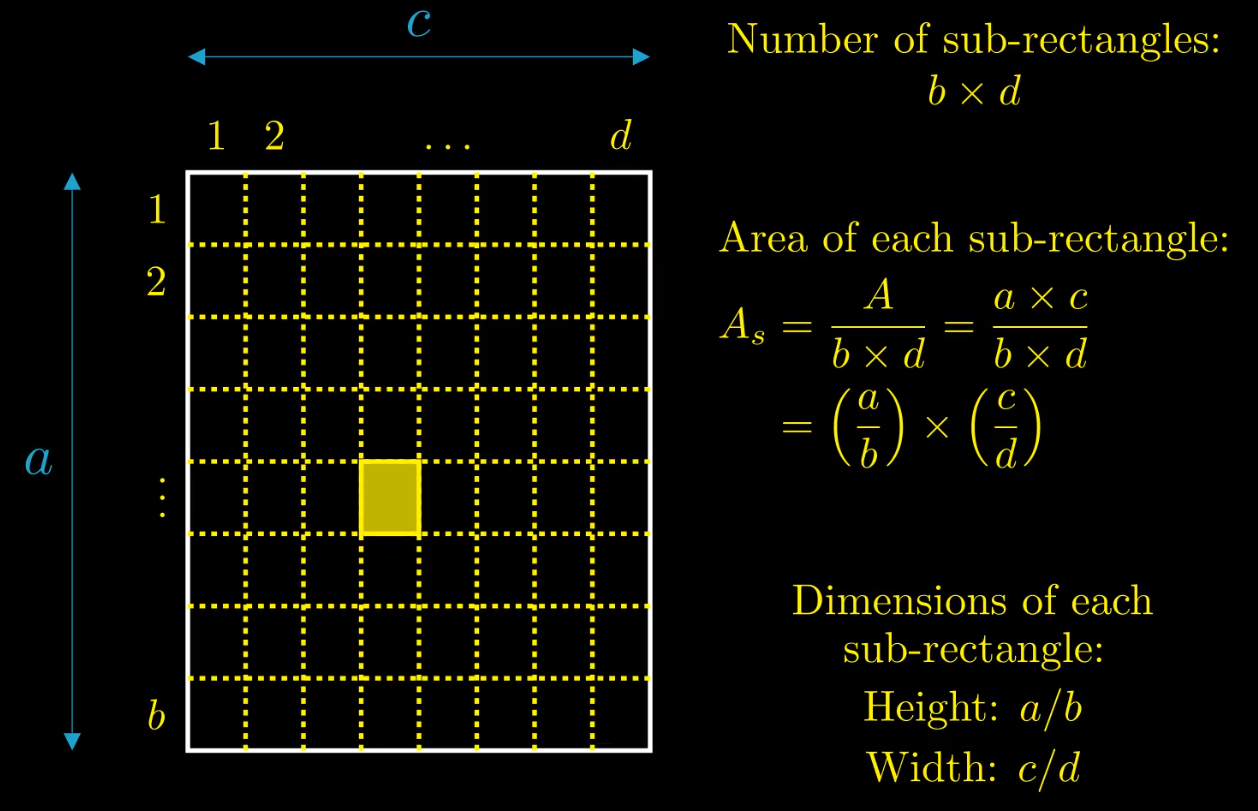
Since, as we previously found, the total area is a·c, the area of each of the sub-rectangles is (ac)/(bd), which happens to equal (a/b)·(c/d), as we saw (Eq. ($\ref{eq: rational multiplication}$)).
Now, zoom in to examine one of these sub-rectangles. Its sides have length (a/b) and (c/d), respectively, since the original rectangle has sides a and c and we split them into b and d equal parts, respectively. Therefore, we conclude that the area of a rectangle of sides (a/b) and (c/d) is equal to (a/b)·(c/d) area units, where the area unit is the area of a square of side 1. This is what we set out to show.
Division
Finally, division is the reverse operation compared to multiplication: it undoes what multiplication does. Multiplying something by a/b splits it into b equal parts and takes a of them. Dividing by a/b undoes this; to undo it, we have to split the result into a parts, (to undo "taking a of them") and take b of them (to undo "splitting into b equal parts"). But this is just multiplying by b/a. Therefore,
$$ \begin{equation} \label{eq: rational division} \frac{c}{d} \div \frac{a}{b} \;=\; \frac{c}{d} \cdot \frac{b}{a} \end{equation} $$The result of the division, let's call it q, q = (c/d)÷ (a/b), can also be seen as the answer to the question "how many times does a/b fit into c/d ?". Indeed, if the quotient q is the answer to this question, then putting together q of the numbers a/b we should obtain c/d; in other words, multiplying a/b by q should result in c/d. This is indeed the case, for, according to eq. ($\ref{eq: rational division}$),
$$ \begin{equation} \label{eq: rational division proof} \frac{a}{b} \cdot q \;=\; \frac{a}{b} \cdot \left( \frac{c}{d} \div \frac{a}{b} \right) \;=\; \frac{a}{b} \cdot \left( \frac{c}{d} \cdot \frac{b}{a} \right) \;=\; \frac{\cancel{a} \cdot c \cdot \bcancel{b}}{\bcancel{b} \cdot d \cdot \cancel{a}} \;=\; \frac{c}{d} \end{equation} $$When the divisor a/b is an integer, say a/b = n, then division by it simply means to split the dividend into n equal parts and take one of them. But this is exactly what the symbol "/" also means, the symbol that we use for fractions. Therefore, by generalising, we use the symbols "÷" and "/" interchangeably.
$$ \begin{equation} \label{eq: division symbol} \frac{c}{d} \div \frac{a}{b} \;\equiv\; \frac{c/d}{a/b} \end{equation} $$Natural and Rational numbers: Recap
So, the natural and rational numbers are abstractions that allow us to quantify discrete and continuous things, respectively. It appears then that we have the tools to quantify everything, and our work is done! However, although indeed from a practical point of view the natural numbers and their derivative rational numbers suffice, it turns out that reality, the world in which we live, is actually more complicated and has aspects that cannot be quantified precisely by these numbers. We will turn to this topic in the next post.