Numbers - Part II: Irrational Numbers
Watch the content of this blog post in the form of a video
In the previous post we examined natural and rational numbers, as abstractions of quantification. In this post we will see that they do not suffice to describe precisely every possible abstract quantity.
Consider again the procedure of splitting each unit interval on the number axis into n equal parts, where n is gradually increased. By continuing this procedure to infinity, any rational number on the number axis will eventually be marked, sooner or later. The distance 1/n between two successive points can be made as small as we wish by taking n large enough. Since there is no restriction as to how large n can be, it is tempting to think that every point on the line will eventually, at some stage, be marked, when n is large enough. This would mean that every point on the line is described by some rational number. But this turns out to be false.
That there are points on the number line that are not described by rational numbers is an amazing discovery made in ancient Greece by the Pythagoreans who, ironically, originally believed that "all things are number", by which they meant rational number – they believed all of reality, at its most fundamental level, to be structured on rational numbers, there being some common measure in everything. The discovery was made probably when the Pythagorean philosopher Hippasos of Metapontion noticed that the side and the diameter of a pentagon are not commensurable, that is, their ratio is not a rational number. On this story I am planning to prepare a separate post. However, the number most famous for not being rational is the square root of 2, and the discovery of its irrationality probably occurred shortly after the discovery about the pentagon. We will see below a few different proofs of the irrationality of √2 – i.e. of the fact that there exists no rational number that when multiplied by itself gives 2.
Of course, one may ask: what is the big deal? Why does there have to be a number such that its square equals 2? Why can't we just say that there is no such number, and stick to our rational number system? The answer is that the rational number system is a device for describing continuous quantities, and continuous quantities can have values whose square is indeed 2 units. This reveals a deficiency in the rational number system – it doesn't fulfil its job description perfectly. But we will say more about this after we present the proofs.
A proof that √2 is irrational
Let the square root of two be written as a ratio of two numbers, a numerator n and a denominator d. This means that the square of this ratio equals 2.
$$ \begin{equation} \label{eq: sqrt2 as ratio} \sqrt{2} \;=\; \frac{n}{d} \;\Rightarrow\; 2 \;=\; \frac{n^2}{d^2} \;\Rightarrow\; n^2 \;=\; 2d^2 \end{equation} $$Could both the numerator and the denominator be integers? This possibility is required if √2 is a rational number. Of course, if the numerator and the denominator can be rational numbers, then it follows that they can also be integer:
$$ \begin{equation} \label{eq: sqrt2 rational to integer} \left. \begin{array}{r} n = a / b \\ d = p / q \end{array} \right\} \;\Rightarrow\; \frac{n}{d} \;=\; \frac{aq}{bp} \end{equation} $$In the above expressions, a, b, p and q are integers, and therefore so are the new numerator aq and the new denominator bp. So the case that n and d are rational is reducible to that where they are integer. But, can they be integer? Equation $\eqref{eq: sqrt2 as ratio}$ shows that, whatever they are, the square of the numerator is twice the square of the denominator. Do there exist integer numbers such that the square of one is twice the square of the other?
To answer this question, we note that the squares of all even numbers are even, and the squares of all odd numbers are odd. So, suppose that the numerator n and the denominator d of a fraction equal to √2 are integer. The right-hand side of equation $\eqref{eq: sqrt2 as ratio}$, 2d2, is even, because of the 2 factor (any number multiplied by 2 gives an even result). Therefore, the left-hand side, n2, is also even, which means that n is even. So, let n = 2k where k is an integer. Substituting this in equation $\eqref{eq: sqrt2 as ratio}$ we get the following:
$$ \begin{equation} \label{eq: sqrt2 similar eqn} 4k^2 \;=\; 2d^2 \;\Rightarrow\; d^2 \;=\; 2k^2 \end{equation} $$We can see that the new equation $\eqref{eq: sqrt2 similar eqn}$ mirrors exactly the old equation $\eqref{eq: sqrt2 as ratio}$. Hence, we have entered a vicious cycle. The new equation $\eqref{eq: sqrt2 similar eqn}$ means that d is also even. But then, just like equation $\eqref{eq: sqrt2 as ratio}$ told us that d is even, so the new equation $\eqref{eq: sqrt2 similar eqn}$, which is of the exact same form, tells us that k is even, and therefore can be written as, say, k = 2j for some integer j; and in a similar fashion it will turn out that j is even, and so on to infinity. Hence both n and d can be divided by 2 infinitely many times, with each division resulting in an integer:
$$ \begin{equation} \label{eq: sqrt2 infinite descent} \sqrt{2} \;=\; \frac{n}{d} \;=\; \frac{n/2}{d/2} \;=\; \frac{n/4}{d/4} \;=\; \frac{n/8}{d/8} \;=\; \cdots \end{equation} $$The numerators and denominators of all these fractions are even integers. Obviously, this is an impossible situation: we cannot have an infinite sequence of smaller and smaller positive integers; if n is the first number of the sequence, then we can at most have n numbers, with the last one being equal to 1. By the way, this is argument is called infinite descent.
Another proof that √2 is irrational
For fun, let us consider another infinite descent proof, with a geometric illustration. Consider a rectangle of sides √2 and 1, respectively, and suppose that √2 is equal to the ratio of integers n/m. Since √2 > 1, it obviously holds that n > m; also, since √2 < 2, it holds that n < 2m. Let us scale the rectangle by a factor of m, so that the lengths of its sides become n and m, respectively, both integers.
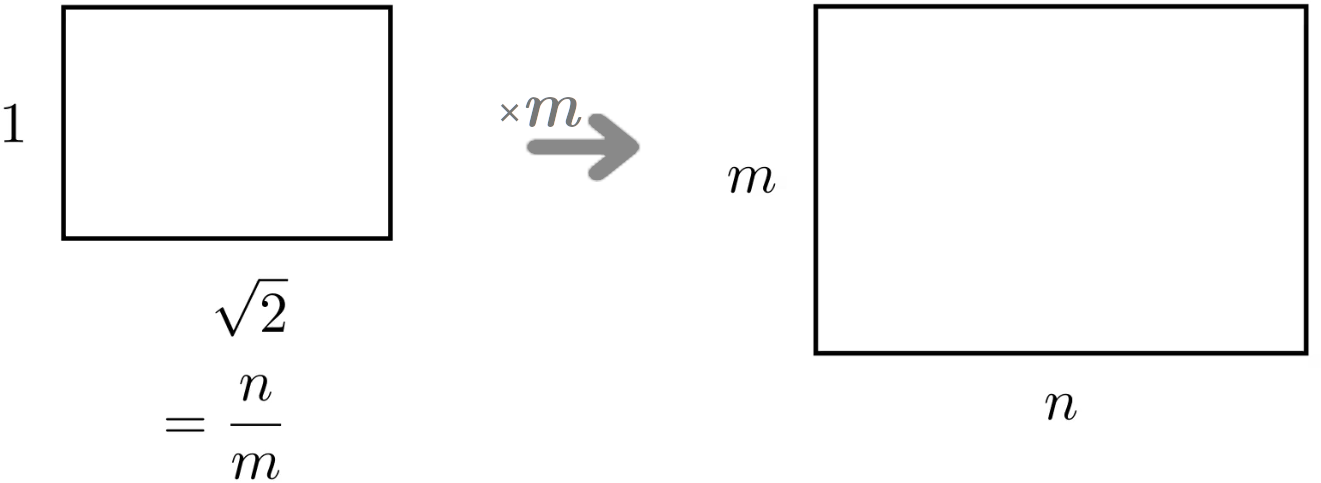
Now mark the point m on the side n, and use it to form a square of side m inside our rectangle. This leaves another rectangle of size (n – m) × m on the right. Next, form another square, of side (n – m), on the bottom of that rectangle. This leaves at the top right corner a rectangle, highlighted in blue, whose sides have lengths n – m and 2m – n, respectively. Since n and m are integers, these lengths, n – m and 2m – n, are also positive integers.
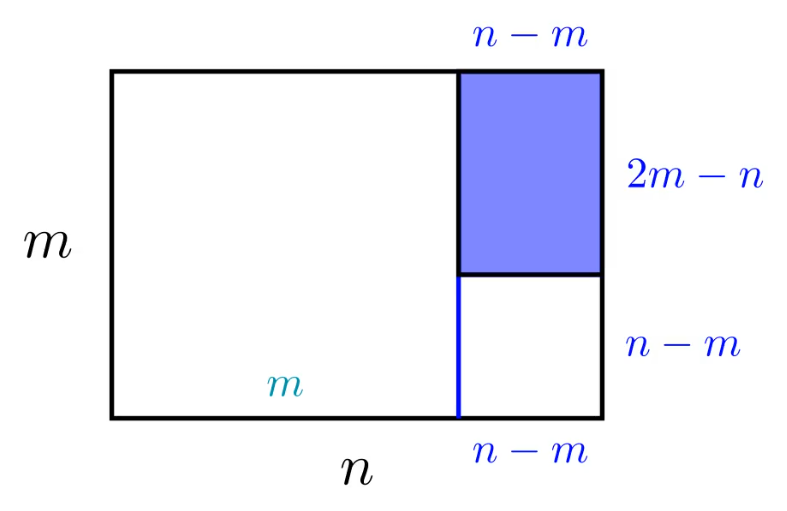
Now, consider the ratio of the sides of this last rectangle:
$$ \begin{equation} \label{eq: proof 2} \frac{2m-n}{n-m} \;=\; \frac{2-\frac{n}{m}}{\frac{n}{m}-1} \;=\; \frac{2-\sqrt{2}}{\sqrt{2}-1} \;=\; \frac{\sqrt{2} \left( \sqrt{2}-1 \right)}{\sqrt{2}-1} \;=\; \frac{\sqrt{2}}{1} \;=\; \frac{n}{m} \end{equation} $$So, the proportions of the top-right rectangle are the same as those of the original one (the former being rotated by 90 degrees compared to the original one); the rectangles are similar. This means that we can repeat the whole procedure all over again on the top-right rectangle, to get an even smaller similar rectangle inside it, whose sides will also have integer lengths. Then, we could repeat again, forming another similar rectangle in that rectangle, and so on to infinity, constructing an infinite sequence of smaller and smaller rectangles all of which have sides of integer length. Again, this is infinite descent, and is impossible.
A large collection of proofs that √2 is irrational can be found in this webpage.
Beyond √2: other roots
Finally, let us look at a more sophisticated proof whose implications, however, go beyond the √2.
Prime numbers and prime factorisations
We will need a result, presented here without proof, which is called the "Fundamental Theorem of Arithmetic". This theorem states that
Any integer greater than 1 can be represented uniquely as a product of prime numbers, up to the order of the factors.
Let us dissect this statement. First of all, what are prime numbers? For those who do not know, prime numbers are integers that do not have other integers as factors; that is, no other, smaller, integer – except 1 – fits inside them an integer amount of times. For example, 9, which equals 3 × 3, and 12, which equals 3 × 4 and also 2 × 6, are not prime numbers; they are called composite numbers. But no smaller numbers fit perfectly into 7, except 1 of course; not 2, not 3, not 4, etc. Therefore, 7 is a prime number. The number one is considered to be neither prime nor composite; it is in a special category on its own.
Prime numbers have intrigued people for millennia. Euclid was an early expert on the subject, and the fundamental theorem of arithmetic can be proved based on knowledge that he discovered. The study of prime numbers and their properties is part of a branch of Mathematics called "Number Theory", for which Carl Friedrich Gauss (1777-1855), one of the greatest Mathematicians of all time, said
"Mathematics is the queen of the sciences − and number theory is the queen of mathematics"
However, in this post we will not delve into Number Theory but simply take the Fundamental Theorem of Arithmetic for granted and use it for our purposes. It says that any integer can be decomposed into a product of primes, and that this decomposition is unique. "Unique up to the order of the factors" means that it doesn't matter in which order we multiply the factors together, which of course gives the same result whatever the order. A factor can be repeated, and the number of times it occurs is important.
For example, 420 equals the product of the factors 2, 2 (again), 3, 5, and 7, and we can reorder them in any way we wish, due to the commutative property of multiplication. But any decomposition of 420 into primes will necessarily consist of these exact factors.
$$ \begin{align*} 420 \;&=\; 2 \times 2 \times 3 \times 5 \times 7 \\ &=\; 2 \times 3 \times 2 \times 5 \times 7 \\ &=\; 7 \times 3 \times 2 \times 5 \times 2 \\ &=\;\ldots \; \text{(whatever other reordering we may think of)} \end{align*} $$What does this imply about the prime decomposition of 420 squared (4202)? Well, obviously one possible such decomposition comes from raising all the factors of the decomposition of 420 to the power 2:
$$ \begin{align*} 420 \;&=\; 2 \times 2 \times 3 \times 5 \times 7 \;\Rightarrow\\ 420^2 \;&=\; 420 \times 420 \;=\; (2 \times 2 \times 3 \times 5 \times 7) \times (2 \times 2 \times 3 \times 5 \times 7) \\ &=\; 2^2 \times 2^2 \times 3^2 \times 5^2 \times 7^2 \\ &=\; 2 \times 2 \times 2 \times 2 \times 3 \times 3 \times 5 \times 5 \times 7 \times 7 \end{align*} $$But the fundamental theorem of arithmetic tells us that there is only one decomposition, so this is it. And in general, the prime decomposition of a number n raised to an integer power q is obtained from the prime decomposition of n by repeating each of its factors q times.
$$ \begin{align} \nonumber n \;&=\; p_1 \times p_2 \times \;\ldots\; \times p_N \; \Rightarrow \\ \label{eq: nq factors} n^q \;&=\; p_1^q \times p_2^q \times \;\ldots\; \times p_N^q \end{align} $$Implications concerning roots
Now, let us seemingly change the subject and consider the product of any two rational numbers (a/b) and (c/d), and analyse their integer numerators and denominators into their prime factorisation:
$$ \begin{equation} \label{eq: product of rationals f1} \frac{a}{b} \cdot \frac{c}{d} \;=\; \frac{a_1 \, a_2 \,\cdots\, a_A}{b_1 \,b_2 \,\cdots\, b_B} \cdot \frac{c_1 \, c_2 \,\cdots\, c_C}{d_1 \, d_2 \,\cdots\, d_D} \;=\; m \end{equation} $$Can the result of this multiplication, call it m, be an integer? It certainly can, but in order for this to be so all the factors in the denominators must cancel out with factors in the numerators. If we have already made beforehand all possible cancellations between the numerator and the denominator of each respective number (such fractions are characterised as irreducible), which means that no factor of a is equal to any factor of b, and no factor of c is equal to any factor of d, then these cancellations must occur across numbers; that is, each factor of b must cancel out with some factor of c, and each factor of d must cancel out with some factor of a.
At this point, one may wonder if it is possible that the product of denominators, b times d, cancels out with part of the product of numerators, a times c, leaving an integer factor m as the result, without, however, the individual factors of b and d cancelling out with individual factors of a and c. The answer to this question is no, and the reason is the following. Equation $\eqref{eq: product of rationals f1}$ can be rewritten like this:
$$ \begin{equation} \label{eq: product of rationals f2} a \cdot c \;=\; m \cdot b \cdot d \end{equation} $$Which can be expanded in terms of prime factors:
$$ \begin{equation} \label{eq: product of rationals f3} a_1 \, a_2 \,\cdots\, a_A \; c_1 \, c_2 \,\cdots\, c_C \;=\; m_1 \,m_2 \,\cdots\, m_N \; b_1 \,b_2 \,\cdots\, b_B \; d_1 \, d_2 \,\cdots\, d_D \end{equation} $$Now, the left and right hand sides are equal, and therefore according to the fundamental theorem of arithmetic the prime factors appearing in them must match. Since each of the b factors does not match any of the a factors, it must match some c factor. And similarly, since each d factor does not match any of the c factors, it must match some a factor.
So, returning to equation $\eqref{eq: product of rationals f1}$ we can conclude that all of the b factors cancel out with some of the c factors, and all of the d factors cancel out with some of the a factors, with the remaining factors of a and c in the numerators, multiplied together, making the integer result m.
Now consider the case that (a/b) and (c/d) are the same number, i.e. that c = a and d = b. Could that product give an integer result?
$$ \begin{equation} \label{eq: self product f4} \frac{a}{b} \cdot \frac{a}{b} \;=\; \frac{a_1 \, a_2 \,\cdots\, a_A}{b_1 \,b_2 \,\cdots\, b_B} \cdot \frac{a_1 \, a_2 \,\cdots\, a_A}{b_1 \,b_2 \,\cdots\, b_B} \end{equation} $$Obviously, this time the factors of the denominators cannot cancel out with the factors of the numerators, since no b factor can equal any of the a factors! So, unless a/b is itself actually an integer, meaning that there are no b factors (i.e. b is equal to 1), (a/b)2 cannot be an integer. This means that a rational number cannot be the square root of an integer. It is very easy to see that the same conclusion holds with the product (a/b) × (a/b) × (a/b) = (a/b)3, and in fact it holds with the general product a/b to the n-th power, (a/b)n. The overall conclusion is this: A non-integer rational number cannot be the square root, or the cubic root, or the n-th root in general, of any integer number. Which means that, if some root of a natural number is not itself also a natural number, then it is also not a rational number; that root, if it exists, is a number of a different kind – an irrational number.
Roots of rational numbers
What about a root of a non-integer rational number? Let us see if it can itself be rational. For simplicity, let us consider a square root.
$$ \begin{equation} \label{eq: root of rational e0} \sqrt{\frac{a}{b}} \;=\; \frac{n}{d} \;\Rightarrow\; \frac{a}{b} \;=\; \frac{n^2}{d^2} \;\Rightarrow\; a \, d^2 \;=\; b \, n^2 \end{equation} $$Now let us again expand all integers into prime factors:
$$ \begin{equation} \label{eq: } a_1 \, a_2 \,\ldots\, a_A \, d_1^2 \, d_2^2 \,\ldots\, d_D^2 \;=\; b_1 \, b_2 \,\ldots\, b_B \, n_1^2 \, n_2^2 \,\ldots\, n_N^2 \end{equation} $$Since all factors on the left-hand side must appear also on the right-hand side, it follows that each a factor must either equal some b factor, or it must equal some n factor. We can exclude the former case by writing the fraction a/b in irreducible form, making all cancellations between numerator and denominator beforehand. This leaves only the second possibility, that any factor of a is equal to some factor of n. But the n factors always come in pairs, so the pair of that n factor must be matched by another a factor; and so the a factors also come in pairs. Hence, a is equal to a product of squares, and therefore is itself a square and its square root is an integer. The exact same holds about b. The conclusion is that √(a/b) is rational only if both √a and √b are integers (because a and b must be squares of integers). In any other case, √(a/b) is not rational.
It is interesting to note that, if √a and √b are irrational (which we saw to be the case whenever they are not integer) then, since their ratio is equal to the square root of a/b, which we just saw to be irrational, √a and √b have no common measure, i.e. no number, whether rational or irrational, can fit into both of them an integer number of times. So, roots are usually incommensurable not only with the integers and the rationals, but with each other as well!
More irrational numbers
If x is an irrational number and r is a rational number, then their sum is also irrational, and so is their product (verify this by assuming that it is rational, and arriving at the contradictory conclusion that x is rational). Of course, the same holds for subtraction and division.
So, √2 is not a specimen of some rare species; rather, irrational numbers seem quite common, and in a sense they are "more numerous" than the rational numbers, since from each rational number (except 0 and 1) we can, by taking roots and performing the usual algebraic operations of addition, subtraction, multiplication and division, derive many – in fact infinite – irrational numbers. But this is not all: there are also irrational numbers that are not derivable from rational numbers through these algebraic operations; such numbers are called transcendental, and there are infinitely many of them as well. Two very famous and important transcendental numbers are π (3.14159...) and e (2.71828…), the numbers of Archimedes and Euler.
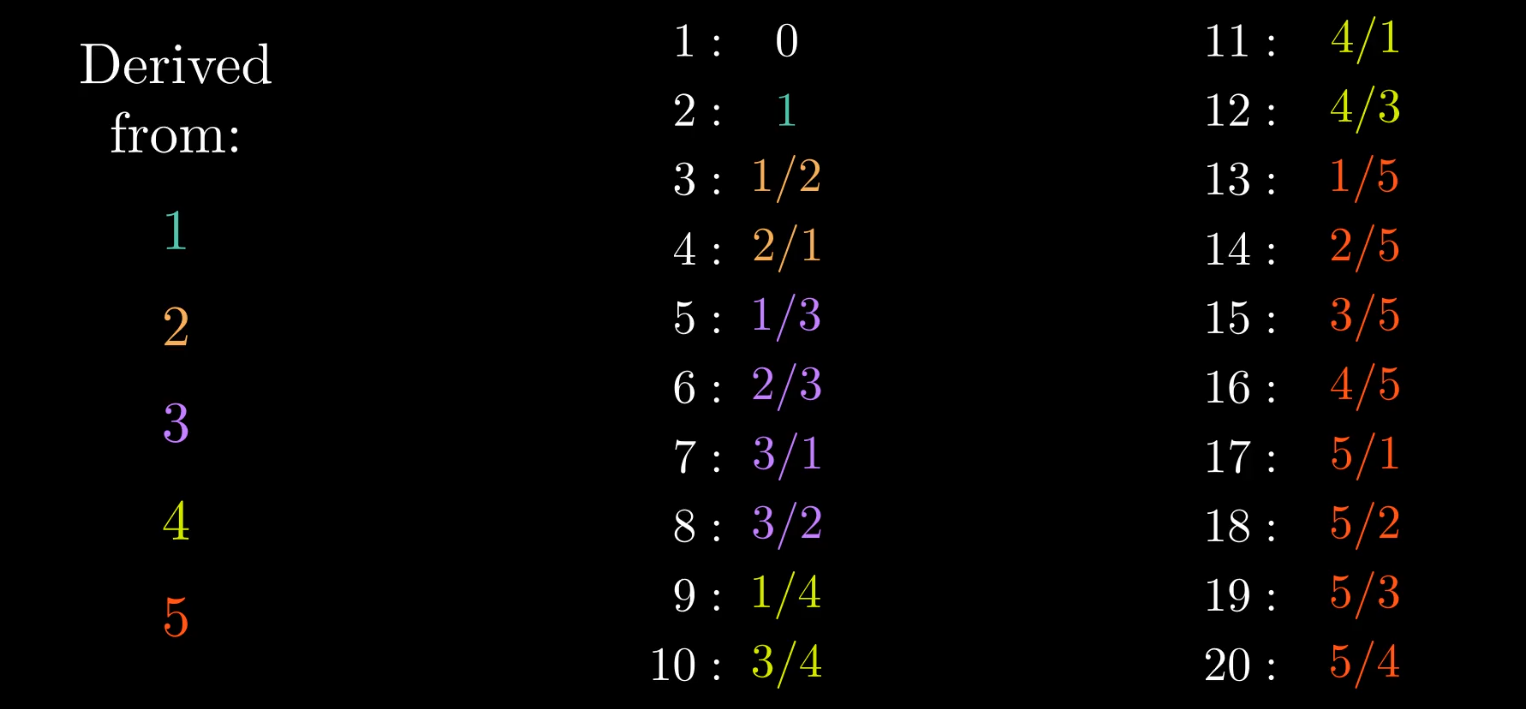
In fact, the transcendental numbers are not countable, that is, we cannot establish a one-to-one correspondence between them and the natural numbers – whereas, surprisingly, rational numbers and the irrational numbers algebraically derived from them are countable, despite the natural numbers themselves being part of them. Indeed, since all of these numbers are ultimately based on the system of natural numbers, the natural way to enumerate them is to list first all the numbers derived based on 1 alone, then those based on 1 and 2, then those based on 1, 2 and 3, and so on. At each stage there is only finitely many numbers involved, and thus we can enumerate them.
For example, and for simplicity, consider the rational numbers only. To enumerate them, start with 0, then list the numbers based on 1, which are +1 and −1, then the numbers that involve also 2, which are +2, −2, +1/2 and −1/2, and so on with the numbers involving also 3, 4 etc. Some numbers may pop up repeatedly (for example, in step 2, two halves makes 1, which was already enumerated in step 1), but we enumerate each number only the first time we encounter it.
The need for irrational numbers
Let us finally address the question posed at the beginning, before we presented all the proofs that no rational number squared makes 2: Why can't we stick to the Pythagoreans' original notion of number, which is that of rational number, and just say that there is no number whose square equals 2? This would be similar to saying that there is no number whose square equals −1, since none of the numbers we have seen so far multiplied by itself gives −1. But what matters is not whether our current number system and operations can give a certain result such as √2 or −1, but whether such a result makes sense. If it does, but our system cannot produce it, then perhaps we are missing some numbers. Numbers are abstractions of aspects of the structure of the actual world. So it is in that structure that we should look for whether a certain result makes sense, and if so, then this would mean that our number system is missing an abstraction of some aspect of the structure of the world, which we could introduce as another number or class of numbers.
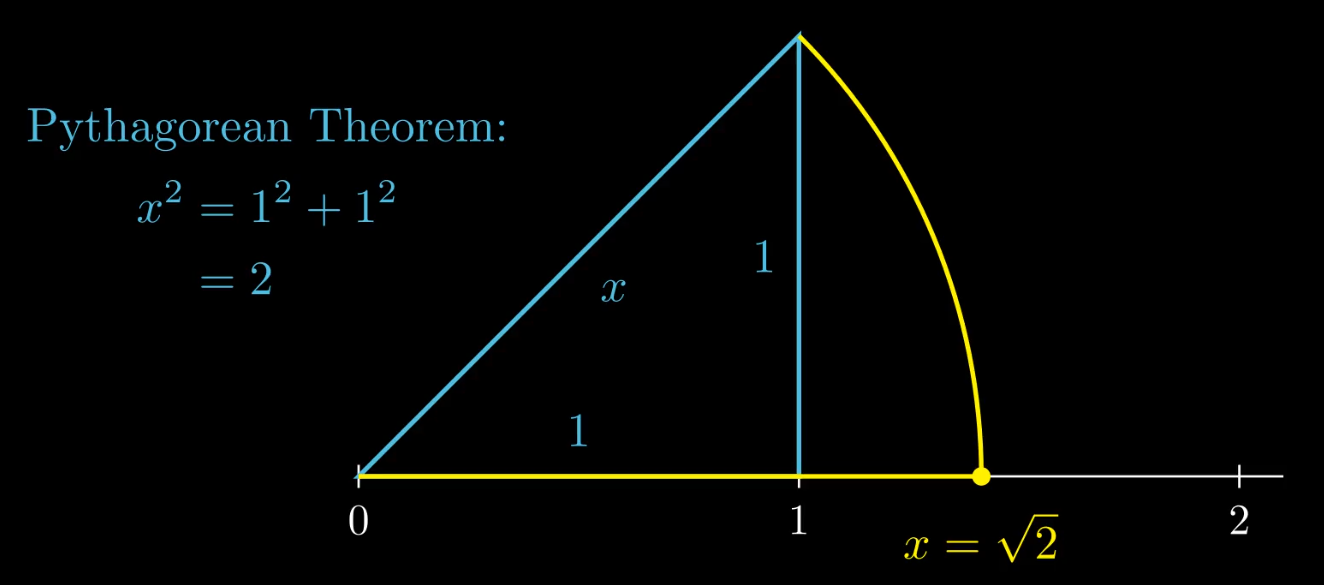
Whether or not an operation makes sense depends on the context. If, for example, we are talking about naturally discrete things such as persons or quarks then the only numbers that are meaningful are the natural numbers, and of course there is no such number whose square equals 2. But the rational numbers are intended for continuous quantities, for which a number whose square equals 2 makes a lot of sense. We know from the Pythagorean theorem that if two sides of a right triangle have lengths of 1 unit then the third side has a length whose square equals 2 units of area. The length of the third side is something real, and its proportion to the length of the unit side is something that can be abstracted and considered to be a number. We can easily mark that length on the number line using a straightedge and a compass, and we have shown that the point that is marked on that line does not coincide with any rational point, that is, with any point that can be marked by subdividing each unit interval of the number line into n equal subintervals and taking m of them, no matter how large we make n. As we increase n, the marked points on the number line become denser and denser, but no matter how dense they become, none of them will ever coincide with the point marked as the √2.
So, for their intended purpose it seems that rational numbers are indeed lacking something, and we need to complement them with the introduction of more numbers that are abstractions of the proportions that are not captured by them. Note that, although we use length as a prototype of a continuous quantity, the same deficiency holds for any other continuous quantity. Take time for example. Suppose that an object moves at a constant speed, and choose the unit of time to be the time it takes for that object to travel a certain distance L. Now, consider the time it takes for that object to travel along a circle of diameter L. Since the length of such a circle is π times L, the required time will be π units. But π is not a rational number. Therefore, while it will take a certain real amount of time for the object to travel around the circle, this amount of time is not describable by any rational number. We could make the same argument for mass, if we assume it to be a continuous quantity (meaning that we neglect its microscopic constitution but view it as a continuum). If a wire of length L has mass of 1 unit, then a circular ring made of that wire with diameter L has a mass of π units.
Of course, one can argue that in real life there are no perfect lines or perfect circles, or perfect right angles or perfectly equal sides, there are no zero-sized points or zero-thickness lines. For any irrational number, we can find rational numbers as close to it as we wish, much closer than the size of any such real-life imperfections. So, from a practical point of view, is there any point in concerning ourselves with the existence of irrational numbers? After all, the rational numbers are completely adequate for any real-life task, and in fact in practice we approximate irrationals with rationals anyway (by using only a finite number of decimals). These arguments are legitimate, but on the other hand it seems that the structure of our reality allows the proportions that are abstracted as irrational numbers, and they do have meaning. They are theoretically important, although practically indistinguishable from the rationals. And our reality is worthy of exploring.
Another source of hesitation for accepting the irrationals as actual numbers may be that whereas the rational numbers can be written precisely, the irrationals cannot. But this objection is not very solid. We are so much used to representing numbers in the decimal system that we tend to consider the numbers and their decimal representation to be one and the same; however, the symbolism of a number is one thing, and the concept of the number itself is another. Just like some natural numbers have arbitrarily been assigned symbols like '1' or '5', yet their meaning, the abstraction they embody, is independent of that symbol, the square root of two could also by assigned an arbitrary symbol, say a mirrored "2", but what matters is the abstraction that that number embodies, which in the context of continuous quantities is as clear as those of the natural numbers. When it comes to rational numbers, the way we write them, as fractions, indicates also the procedure by which they may be attained – we make this description part of their symbolism. As for decimal notation, this is an extra layer on top, a more practical mechanism for obtaining these numbers (this will be the subject of another post). Indeed, these procedures and mechanisms are unable to produce precisely an irrational number, and hence we cannot exactly write irrational numbers using the same language or writing system that we have adopted for the rationals. But calling the number in question "the square root of 2" or writing it as √2 already contains the necessary information needed to get that number, just like 15/32 contains the information of how to obtain that number.
Epilogue
This brings us towards the end of our basic exploration of the nature of numbers. The imaginary and complex numbers have been left out, to be dealt with in another post. In a follow-up post I am planning to present the history of the discovery of incommensurability and irrational numbers by the Pythagoreans. Also, there will be another post about our system of representing numbers, namely the decimal system.
Let us end this video on a philosophical note, by contemplating a bit about the deeper importance of the things that we discussed. The field of Mathematics was developed due to our realisation that the reality in which we live has a non-physical structural component that is very rich and deep. This structural aspect is accessible to a faculty of ours that we call reason. Using our reason, we can make discoveries about it. In science, we need to use both our reason and our senses to make observations, because the physical laws, and the physical part of our universe in general, seem to be contingent and not logically necessary. But the objects and relationships that pertain to the abstracted, structural part of reality which Mathematics studies seem logically necessary, and hence in mathematics reason alone seems to suffice. Like the physical world, the mathematical world is also very complex, and although accessible to our reason without the need of the senses, it still takes effort, time and ingenuity to make discoveries. Observations, although not necessary, may still be quite useful. There is a great deal of things to discover about the abstract, mathematical fabric of the world. Even its most basic elements, the natural numbers, although on first glance seem unremarkable and very similar to each other, yet each of them has its own distinct character and individuality. To illustrate this point, let me quote a very striking passage from the insightful little book "Numbers: A very short introduction" by Peter Higgins:
"One of the glories of numbers is so self-evident that it may easily be overlooked – every one of them is unique. Each number has its own structure, its own character if you like, and the personality of individual numbers is important …
A prime number is a number like 7 or 23 or 103, which has exactly two factors, those necessarily being 1 and the number itself... We do not count 1 as a prime as it has only one factor. The first prime then is 2, which is the only even prime, and the following trio of odd numbers 3, 5, and 7 are all prime. Numbers greater than 1 that are not prime are called composite as they are composed of smaller numbers. The number 4 which equals 2 times 2, or 2 squared, is the first composite number; 9 is the first odd composite number, and, equalling 3 squared, is also a square. With the number 6 which equals 2 times 3, we have the first truly composite number in that it is composed of two different factors that are greater than 1 but smaller than the number itself, while 8, which equals 2 to the power of 3, is the first proper cube, which is the word that means that the number is equal to some number raised to the power 3.
After the single-digit numbers, we have our chosen number base 10, that equals 2 times 5, which is special nonetheless being triangular in that 10 = 1 + 2 + 3 + 4 (remember ten-pin bowling). We then have a pair of twin primes in 11 and 13, which are two consecutive odd numbers that are both prime, separated by the number 12, which in contrast has many factors for its size. Indeed, 12 is the first so-called abundant number, as the the sum of its proper factors, those less than the number itself, exceeds the number in question: 1+2+3+4+6 = 16. The number 14 which equals 2 times 7 may look undistinguished but, as the paradoxical quip goes, being the first undistinguished number makes it distinguished after all. In 15 which equals 3 times 5, we have another triangular number and it is the first odd number that is the product of two proper factors. Of course, 16, which equals 2 to the power 4, is not only a square but the first fourth power (after 1), making it very special indeed. The pair 17 and 19 are another pair of twin primes, and I leave the reader to make their own observations about the peculiar nature of the numbers 18, 20, and so on. For each you can make a claim to fame".
Peter Higgins "Numbers: A very short introduction", p. 8-9, Oxford University Press, 2011
Let me end with some personal thoughts. We said that, while the physical world seems contingent, the mathematical world seems logically necessary. Indeed, to understand the physical world we employ inductive reasoning, which means that we reach conclusions that are probable, based on the evidence we observed and the familiarity with the mechanics of the world that we acquired during our lifetimes; whereas to understand the mathematical world we use deductive reasoning: we use our reason alone to logically reach conclusions that are certain. But, at a deeper level, could it be that even the mathematical world, with its entities and its laws, is somehow contingent as well? I tend to believe so. The rules of logic tell us when something follows necessarily from the premises. But where do the rules of logic themselves follow from? To try to logically explain the existence of logic seems like trying to pull oneself up from their own bootstraps. Reason and logic are our inherent and instinctive capabilities of a priori understanding and knowing how certain aspects of reality work, and everyday experience confirms that reality indeed works this way. This ability is an inextricable part of our nature, and it is mysterious and ultimately inexplicable. But in my personal opinion, there is indeed a sort of contingency even in the part of reality that is accessible to us through reason and logic.

For those of you who, like me, are theists, consider this question. Philosophers sometimes invoke the concept of "possible worlds" in their arguments, by which they mean theoretical worlds or realities, possibly different than ours, which, however, do not violate any logical laws. On the other hand, an "impossible world" is a theoretical world that does violate some logical law or laws, and therefore could never exist. In the philosophy of religion it is often said that God could have made any of the possible worlds instead of ours if he so chose, but even he could not have created any of the impossible worlds. Personally, I find this statement naive and simplistic. It reveals a superficial way of thinking. Who forces the laws of logic upon God? Isn't he the source of everything, including logic? Or does he exist inside a world larger than him, a world independent of him, an eternal reality with its own logical laws to which even he is unavoidably subject? A world of eternal Platonic Ideas perhaps. But where does this world come from, where does it originate from, if not from God?
Or, to get back to the closely related topic of Mathematics: monotheists believe that there is one God; and Christians, like me, believe there to be three divine Persons. Does this mean that natural numbers, such as one and three, contrary to what Kronecker said (see the previous post), are not God's creations but are somehow uncreated, eternal, divine, part of God's nature? Does it mean that God, or some aspects of him, is describable in mathematical terms? And that this is just the way it is, independently of him, a nature forced upon him?
If I had to bet, personally I would guess that even the realms of logic and mathematics are, at a deep level, contingent and dependent upon God. They do not belong to the "uncreated" realm, to which only God belongs, although their foundations go deeper than those of the physical realm.
How can this be? How can a purported contingency of mathematics be reconciled with the attributes of God? How could "impossible" worlds be possible? To be honest, I do not know the answers to these questions, but I believe that it is so. Some things just transcend our ability to understand.
But anyway, this discussion has become quite heavy. This is just my personal thoughts, and food for thought. In the next post we will return to the more mundane but still wondrous world of mathematics.