The Discovery of Incommensurability in Antiquity
Watch the content of this blog post in the form of a video
In a couple of previous posts we saw that the concept of natural numbers emerges naturally, as an abstraction, from the nature of discrete things like persons, apples, pebbles, etc., and the fact that multiple of them can exist, with no conceptual upper bound in their number (if we neglect physical limitations). We also discussed continuous quantities, like distance, time, mass, volume, intensity etc. In order to measure such a quantity, we first need to choose an arbitrary amount of it and designate it as a unit – e.g. a foot, a day, a litre, a kilogram etc. Then, the procedure of measurement is essentially a comparison against this unit. We would like to consider the result of this comparison as a number. It is essentially the analogy, or ratio, of our given amount compared to the unit.
The most straightforward case is that where our given amount is a perfectly integer multiple of the unit, e.g. 2 feet, 3 days or 5 kilograms. In such cases we simply consider the measure of our amount to be the corresponding natural number. But if the unit does not fit perfectly into our amount then things are more complicated. Since the natural numbers are a concept that we are innately familiar with, we can use them to construct a derivative number system for continuous quantities, where the unit is split into an integer number of sub-units. For example, an inch is 1/12th of a foot, an hour is 1/24th of a day, and a gram is 1/1000th of a kilogram.
But there are no restrictions in our choice of sub-unit; we can divide the unit into as many sub-units as we wish: the possible subunits are as many as the natural numbers – infinite. Then, instead of comparing our given amount against the unit, we compare it against some subunit. Our goal is to choose a suitable subunit such that the ratio of our amount to that subunit is an integer, or, to say it differently, such that the subunit "fits into" our amount an integer number of times. If the chosen subunit is one n-th of the unit, i.e. equal to 1/n, and it fits m times into our amount, then the proportion of our amount compared to the unit is what we call the rational number "m/n".
Since the sub-units can be arbitrarily small, and there are infinitely many from which to choose, it may seem that any arbitrary amount of some quantity can be precisely decomposed into sub-units, and hence that the rational number system can describe the analogy between any arbitrary amount of a quantity and any chosen unit of that quantity.
In antiquity, the early Pythagorean philosophers believed so, and this belief was central to their world view. They believed that there is a unified harmony in nature where all analogies can be expressed as integer ratios. The mystical scaffold of the universe is the natural numbers. However, it turned out that this is not the case, and it was the Pythagoreans themselves who discovered it.
In this post we will trace the history of this discovery. Some of the resources on which our account is based are listed below. Of particular interest is the first one, a 1945 academic paper by a German philologist named Kurt von Fritz.
- Von Fritz, K. (1945). The discovery of incommensurability by Hippasus of Metapontum, Annals of Mathematics, vol. 46, No. 2, p. 242-264.
- Morrison, J. S. (1956). Pythagoras of Samos, The Classical Quarterly, vol. 6, p. 135-156.
- Demand, N. (1973). Pythagoras, Son of Mnesarchos, Phronesis, vol. 18, p. 91-96.
- Huffman, C. (2024). Pythagoras. In: Zalta, E. N. & Nodelman, U. (Ed.),
The Stanford Encyclopedia of Philosophy, Metaphysics Research Lab,
Stanford University. https://plato.stanford.edu/entries/pythagoras/ - Osborne, C. (2004). Presocratic Philosophy: A Very Short Introduction,
Oxford University Press.
Kurt von Fritz
Kurt von Fritz was a remarkable person, and since the present video has a historical perspective, it is only fair that we begin with mentioning briefly some biographical details about him. He was born on the 25th of August 1900, and died on the 16th of July 1985. He was a German professor of Classical Philology. He came from a military family and although he also had an interest for philosophy, mathematics and science, he was eventually won over by classics, when he heard a lecture by Edward Schwartz in 1919 on the Greek historian Thucydides, who described the fall from civilisation to barbarism during the Peloponnesian war. It seems that Kurt von Fritz valued human persons and their relationships more than the marvels of the inanimate universe, and in classics he found the childhood of modern culture, which was crucial for its shaping. But, being adept in mathematics, he was very suitable to undertake the task of presenting the history of the discovery of the irrationals, doing some detective work in the process in order to clarify some details that were disputed.
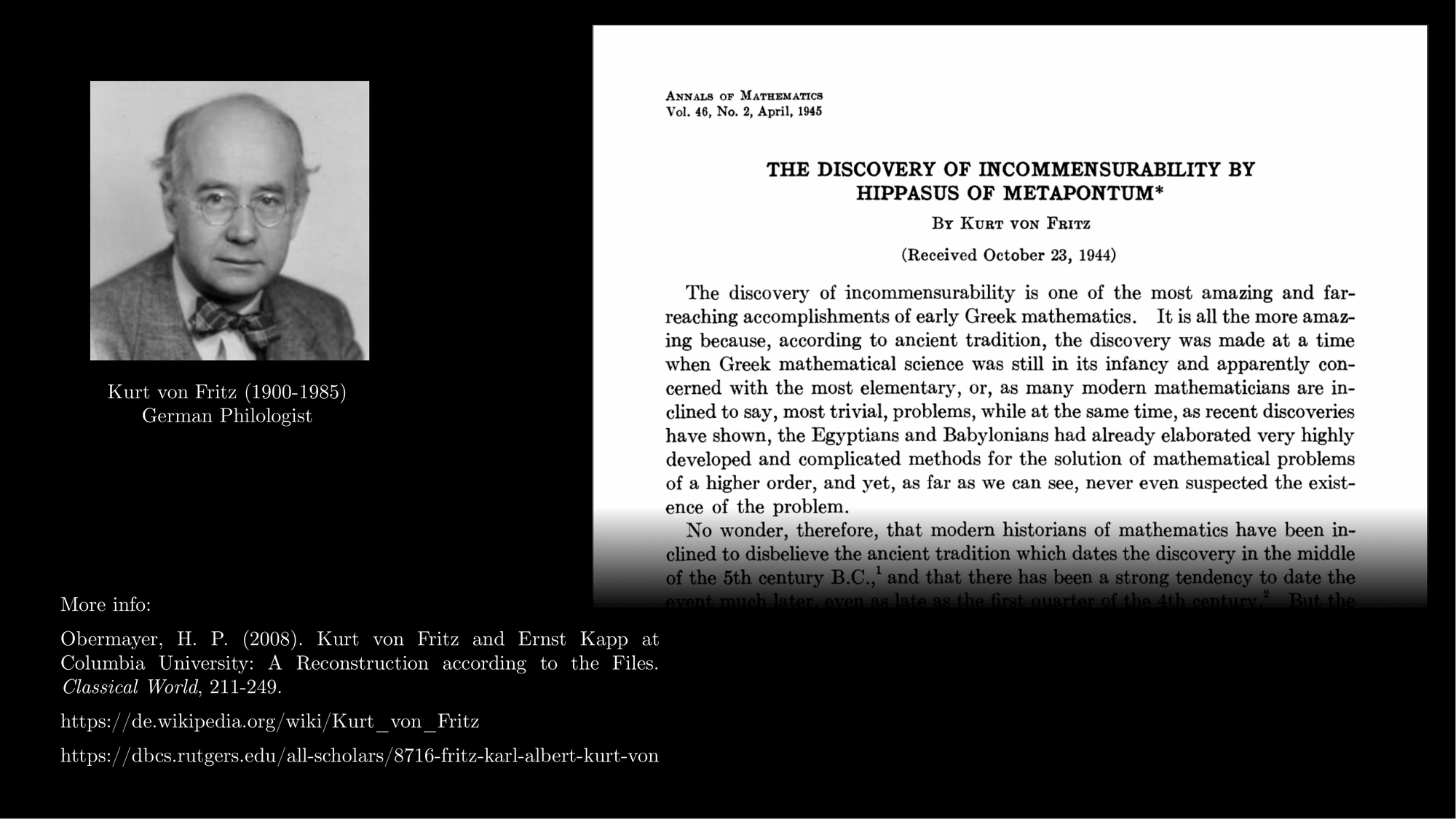
His intellectual energy and vision was matched by his morality; in 1933 he received an associate professorship for Greek at the University of Rostock, his first, but with the rise of the Nazi party to power every employee of the German government was required to sign an oath to Adolph Hitler. He refused (he was only one of two professors to do so), and hence was suspended and eventually removed from his position. In fact, he was thereafter denied any possibility of working as an academic in Germany under that regime. In 1936 he went to Oxford, and in the same year travelled to the U.S.A. where he taught mostly at Columbia University until he returned to Germany in 1954 to teach at the Free University of Berlin and from 1958 onwards at the University of Munich.
Pythagoras: his life
The second character that we need to succinctly introduce is the far more ancient figure, Pythagoras. The revelation of irrational numbers is credited to the philosophers of the Pythagorean school. Moreover, the number most renowned for being irrational is √2, which arises organically in relation to the Pythagorean theorem. These facts may give the impression that Pythagoras was a great mathematician. However, this does not appear to have been the case; yet his successors did develop mastery of mathematics, motivated by their school founder's attribution of mystical significance to numbers.
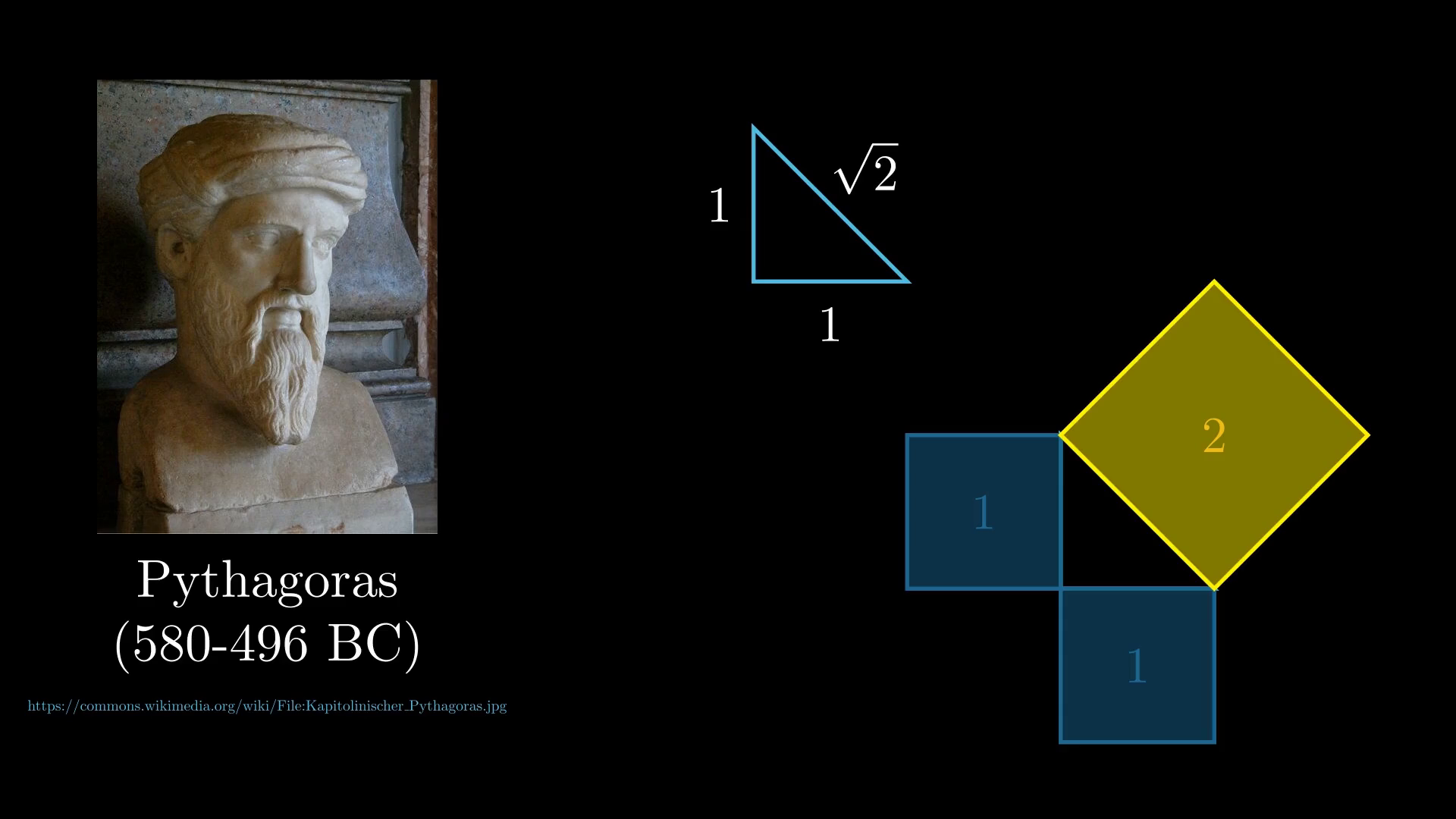
Pythagoras was a very important ancient philosopher who had great influence on ancient philosophy, through which he left an imprint on the Western civilisation up to the modern era. Unfortunately, information about him is rather scarce, most of it coming from later writers, recorded many centuries after his death, and polluted with legends.
Indeed, Pythagoras made a deep impression on the ancient world, acquiring a mythical status and a reputation for being a wonder-worker and having supernatural abilities. For example, he supposedly had a golden thigh, he was associated or even identified with the god Apollo, he had a magical golden arrow given to him by Abaris the Hyperborean shaman which allowed him to fly to distant places, and he allegedly was seen simultaneously at two different cities, one in southern Italy and one in Sicily, conversing with friends. Many discoveries or theories of his successors or other later ancient philosophers were attributed to him.
Nevertheless, from the various accounts we can piece together a rough credible biography. He was born in the Greek island of Samos, at about 570 BC. He was the son of Mnesarchos, a gem engraver, and Pythais, a woman belonging to an aristocratic family of the island. At that time, the art of gem engraving was at the forefront of technology and going through a revolutionary phase with many innovations taking place, and the Greeks likely learned the new techniques from the Phoenicians, with whom they were in contact in Cyprus. Pythagoras' father, and Pythagoras himself, likely travelled to foreign lands such as Egypt and Phoenicia to learn about the new techniques and engage in commerce. This brought Pythagoras into contact with the wisdom of other cultures and stimulated his inquiring spirit.
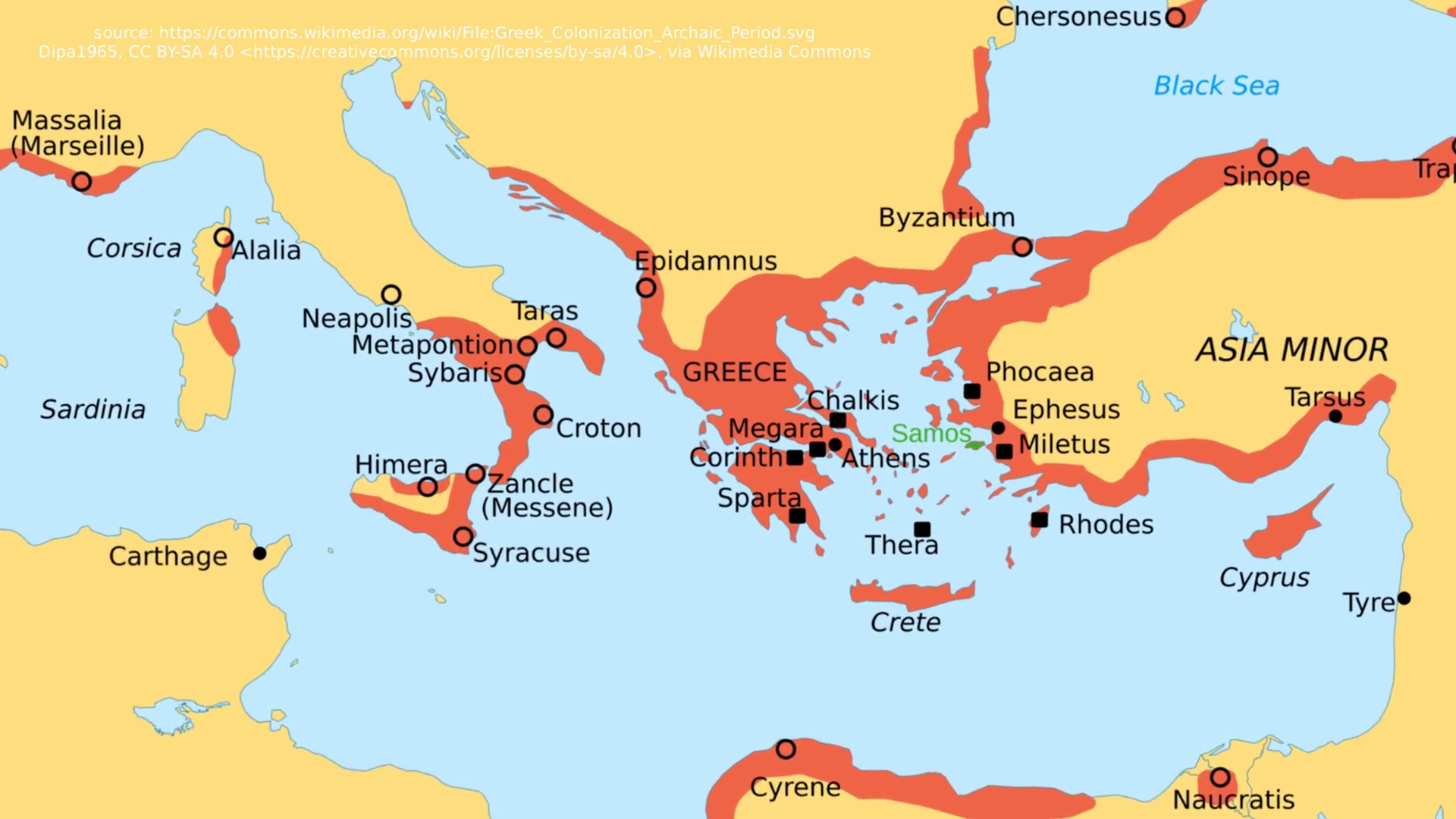
Furthermore, just across the sea from Samos there was the important intellectual hub of Miletus which had recently become the site of origin of the Greek philosophical and scientific tradition, a tradition that quickly spread to other parts of Asia Minor and of the Greek world in general, and certainly to nearby Samos. Philosophers such as Thales, Anaximander and Anaximenes were the first to attribute phenomena to natural rather than supernatural causes and proposed that the world is structured from some single ultimate substance, holding different views as to which element that might be, among those proposed being water, air, fire and an indefinite substance called apeiron. But Samos itself was also one of the most advanced places of the Greek world of that era, with technological achievements such as the Eupalinian aqueduct and the temple of Hera.
Pythagoras initiated some philosophical activity in Samos, gathering students and forming an intellectual circle, already gaining fame in the Greek world. However, it seems that he wasn't on the best of terms with the tyrant of Samos, Polycrates, which resulted in his migrating to the city of Croton, in what is now southern Italy and was at that time part of a region later called "Μεγάλη Ἑλλάς", or "Magna Graecia" in Latin, which means "Great[er] Greece". Starting from a couple of centuries prior, the Greeks had established a large number of colonies in southern Italy and Sicily, which during the time of Pythagoras and the ensuing century (an era when the Pythagoreans were very influential in the region) were very prosperous and culturally and economically advanced – which is likely why this region was named "Greater Greece".
Pythagoras' migration to Croton took place around 530 BC, when he was about 40 years old. When Pythagoras arrived in Croton, the morale of its citizens was very low as they had recently been defeated with heavy losses by the Locrians at the battle of the Sagras river, despite outnumbering them by a large margin. Pythagoras, already highly reputed as a 'sophos' (a wise person), when he arrived, managed to boost the morale by praising and highlighting the merits of a simple, non-luxurious life that focuses on the cultivation of virtue, reforming or reintroducing cultural and religious institutions of the older Greek civilisation.
He became highly influential, as the city's authorities invited him to hold a series of seminars towards separate groups of boys, young men, girls, and married women. His activity had a positive effect on the people of Croton, and their city flourished in the years that followed, forming a sort of hegemony among the neighbouring Greek city-states, while Pythagoras himself gained much influence and power.
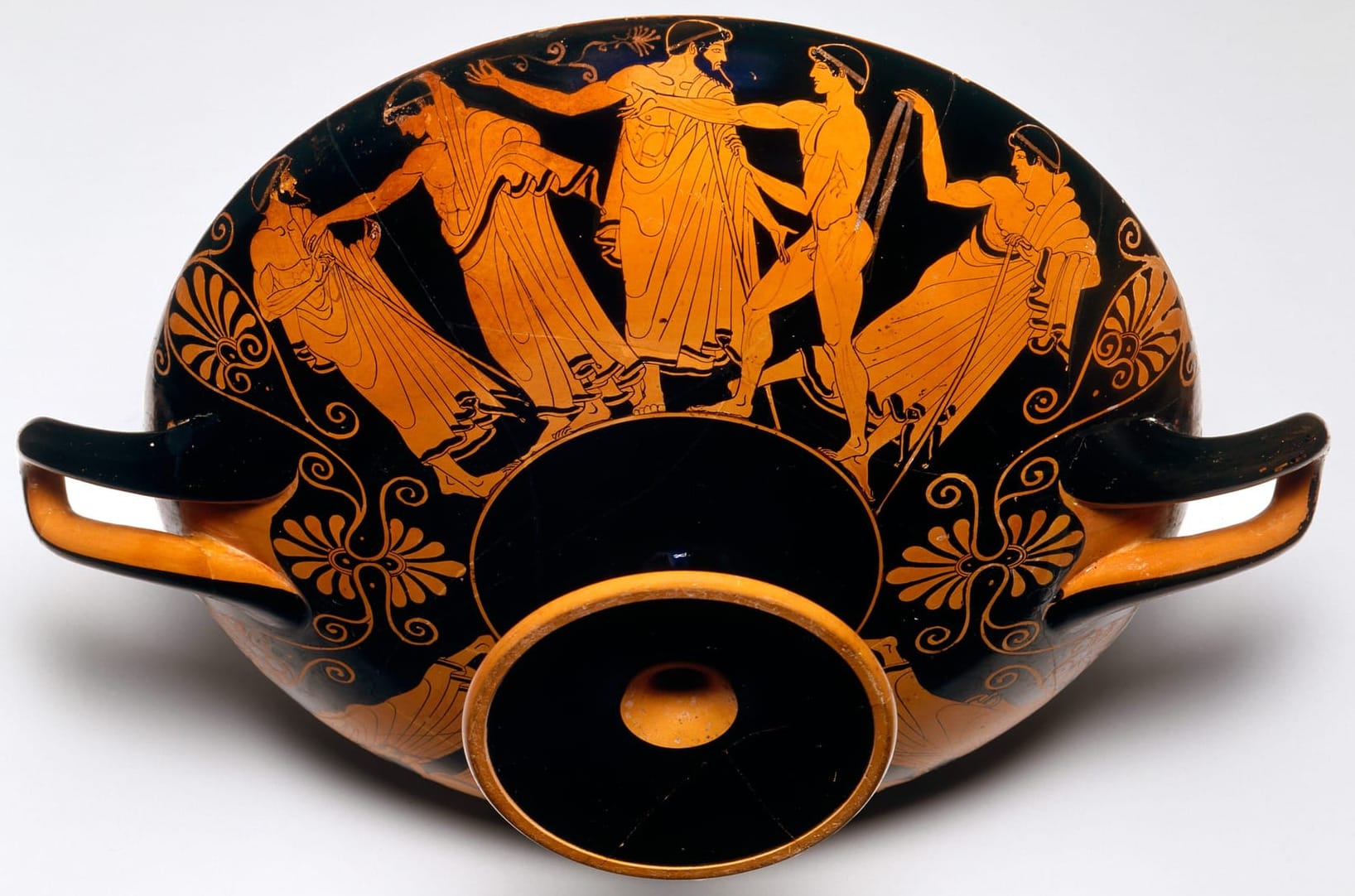
However, he also formed a closed, privileged society or brotherhood of elite young members. They formed an exclusive club, with strict rules of conduct, rituals, and a somewhat communal way of life. The members of this brotherhood later occupied places of power in society and in the city governance, as they came from elite families. Thus, the Pythagoreans gradually obtained much power and influence in Magna Graecia. This eventually led to suspicion, jealousy and animosity in the general population, with several movements or revolts taking place against them, the first of which took place when Pythagoras was still alive, in old age, which forced him to leave Croton and move to nearby Metapontion (Latin: Metapontum), where he stayed for a short period until his death.
Pythagoras: his teaching
What was Pythagoras famous for in the ancient world? Was he regarded as a great mathematician, like most modern people assume him to have been? The answer is no. Rather, Pythagoras was known for the following.
First of all, he was considered to be an expert on the fate of the soul after death. Pythagoras taught that the soul is immortal, and that after death it transmigrates into another body, whether human or animal. Possibly, each soul's transmigrational path is determined by how it lived its previous lives, undergoing judgement after each death, hence the need for a particular virtuous way of life, called Pythagorean life. The doctrine about judgement is not explicitly mentioned as a Pythagorean teaching in our available sources, but it is found in the Orphic religion and in Plato's philosophy, both of which have close similarities with the Pythagorean beliefs and are most likely related.
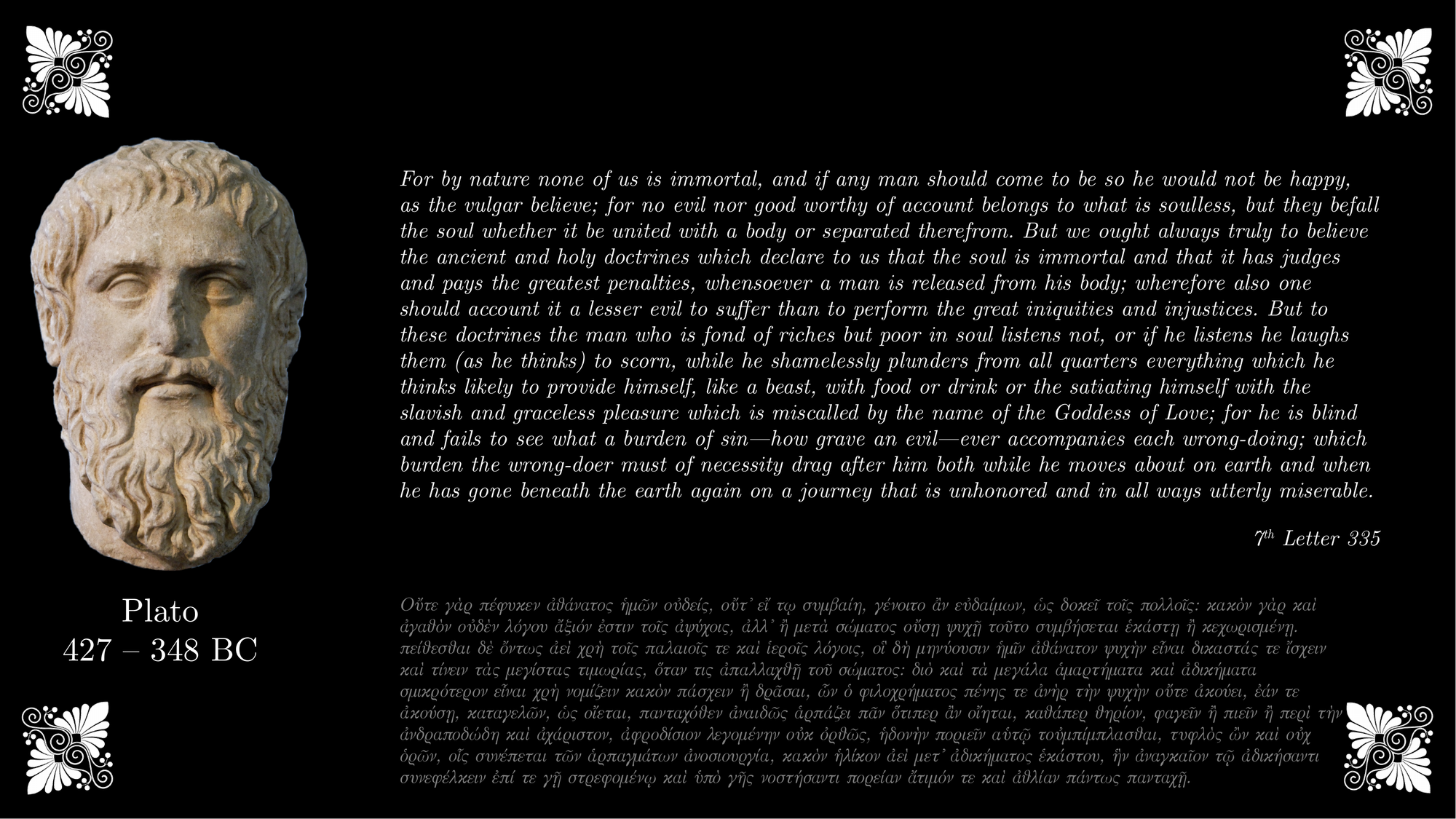
So, Pythagoras was also famous as a teacher of a way of life. In the ancient world, philosophy was not restricted to an academic, theoretical discipline, but it was much wider in scope and was also practical in nature, aiming to discover and apply the way of life that leads to fulfilment. It had to do with the meaning of the human life. As such, it was more holistic than the modern concept of philosophy, incorporating many elements that would today be classified as religious or spiritual. Pythagoras placed emphasis on sacred religious rituals, abstention from certain kinds of foods, ritual purity, and even on certain prohibitions and regulations that may seem meaningless and puzzling to us, such as that one should always put on the right sandal before the left one. Presumably, this way of life was designed to purify the individual that abides by it and help them to accomplish progress in the perpetual cycle of reincarnations. Interestingly, Pythagoras did not discriminate as much between men and women, contrary to the norm in the ancient world, and there were several women among the Pythagorean philosophers. The Pythagorean belief and life system was probably not something completely novel, but a refinement or reformation and systematisation of earlier Greek traditions, particularly those related to the Orphic religion.
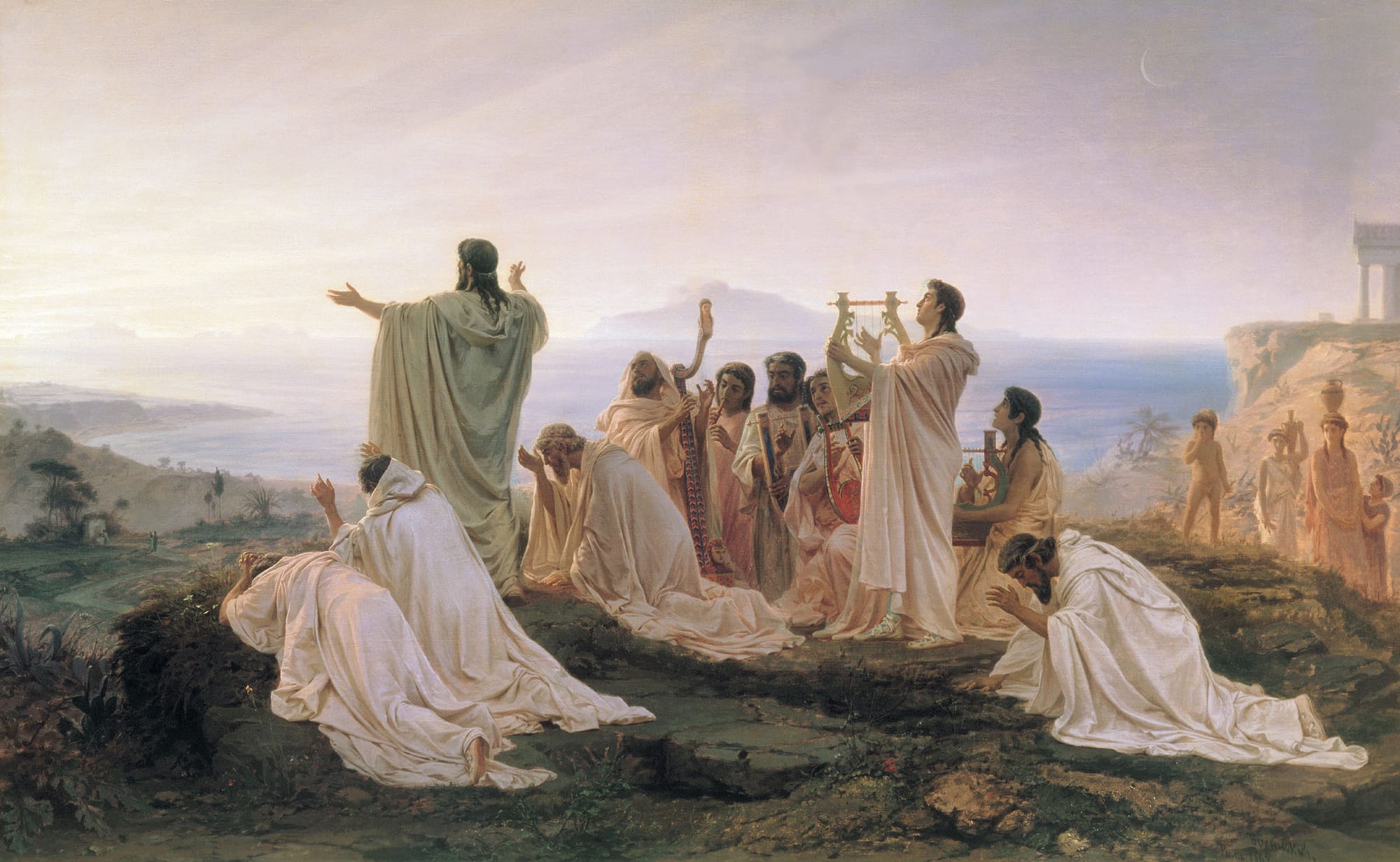
Finally, what is of particular importance for the present topic is Pythagoras' fascination and obsession with numbers. He did not, however, seem interested in them from a purely mathematical perspective but rather from a cosmological perspective, believing them to be fundamental elements of the world that we live in. Aristotle went as far as to claim that the Pythagoreans believed that "all things are numbers", in a similar sense that, for example, other philosophers of that time believed all things to consist of water, air, or fire. But this is likely an exaggeration. What Pythagoras and his followers likely believed was that numbers are part of the deepest nature of things, with everything having a mystical resemblance, or something in common, with a number or with a ratio of numbers, and that numbers and their ratios in some sense explain or govern things.
They found some empirical evidence to support this belief in the observation that the central musical concords (the octave, the fifth and the fourth), originally defined empirically from the way they sound to our ears, correspond to integer ratios of lengths in the instruments that produce them (e.g. the length of a chord, the thickness of a disc, etc.). Given that music itself was regarded very highly in Greek culture and often considered to have some connection to the divine realm, this reinforced the Pythagoreans' conviction in the mystical power and significance of numbers. They went on to postulate that, since sound is related to motion, the motion of the stars and planets, governed by mathematical ratios, is associated with an inaudible music of the heavens.
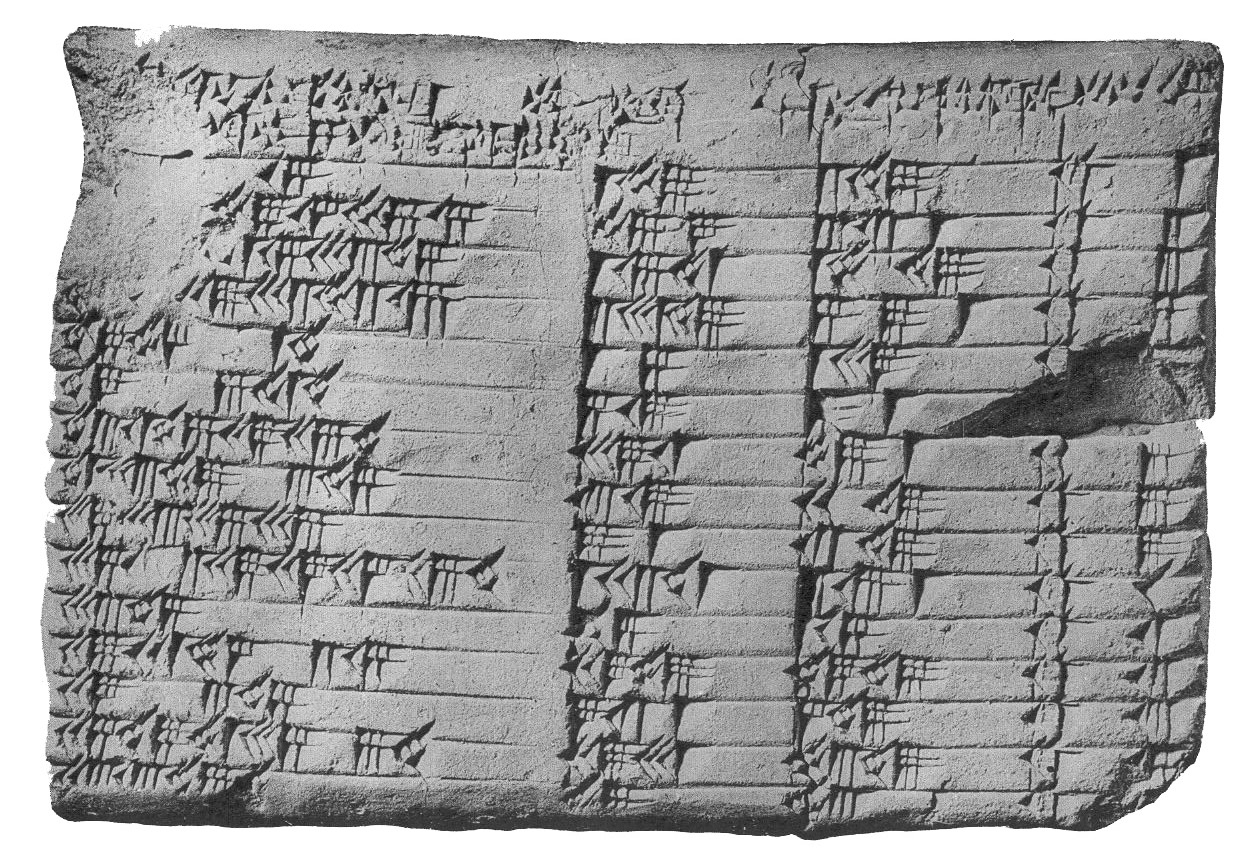
Concerning the Pythagorean theorem, it is unlikely that Pythagoras produced any formal proof of it. Rigorous mathematics had not yet begun to develop in Greece, although they would shortly after Pythagoras' prime. However, the truth of the theorem was empirically known as an arithmetic technique without proof to civilisations of the Middle East such as the Babylonians, and it is likely that Pythagoras came to know of it. Probably, the truth of the theorem was not known in its general form, but for specific triangles of integer sides – for example, the simplest such right triangle has sides of 3, 4 and 5 units (by the way, triplets of integers that can be the sides of a right triangle are called "Pythagorean triples" and the corresponding right triangles are called "Pythagorean triangles"). In arbitrary cases, one could make imprecise measurements, which nevertheless hinted to the general validity of the theorem. So, it is possible that Pythagoras became aware of the truth of the theorem, without being able to prove it formally. It is said that upon discovery of this fact, Pythagoras was elated and sacrificed oxen to the gods in gratitude, likely perceiving it as further evidence of the mystical significance of numbers and their fundamental role as constituents of the fabric of the universe.
So, the engagement of early Pythagoreans with numbers was more akin to mysticism rather than mathematics. For example, they likened the female to the number two and the male to the number three, while their sum, five, was likened to marriage. The tetraktys, which literally means "the four" means the group of the first four numbers (1, 2, 3 and 4), which when added together equal the number 10, thought of as the perfect number. They are also the numbers making up the ratios of the basic concords in music. The tetraktys was thus an important sacred symbol in Pythagoreanism.
To summarise, Pythagoras' Cosmos was one that had a moral purpose, exhibited in the immortality of the soul, reincarnation, and judgement; but it also embodied mathematical relationships, not as a separate aspect but somehow as one with the moral. This confusion between the realms of ethics and logic is to some degree inherent also in the philosophy of Plato. To me, this does not seem like a viable marriage, and hence eventually, in the modern western world, the aspect of logic and mathematics seems to have taken the upper hand while the soul and ethics have been demoted from the status of fundamental to something derivative, to products of the physical world.
Indeed, in modern, Western, developed societies, the prevalent world view among intellectuals is "physicalism", which is the view that everything is ultimately explainable by physics: The world consists of fundamental physical particles that interact with each other according to certain laws (the laws of physics), and everything that we as humans perceive macroscopically can be explained according to these laws, even things such as consciousness, human life, and their associated aspects of life such as right and wrong, good and evil. Personally, I do not embrace this view – but this can be a topic for another post.

If we measure Pythagoras' views against this prevalent modern view, they seem, at first glance, to be antithetical. Pythagoras' teachings about the immortality of the soul and about the transmigration of souls hints at a dualistic understanding of reality (dualism is a competitor philosophical theory to physicalism, which holds that human persons and mental phenomena, or aspects of them, are beyond the realm of physics; they are non-physical and immaterial – personally, I feel much more at home with the dualistic world view and I consider it to be much closer to the truth than physicalism or materialism). But Pythagoras' other tenet, that "all things are number", if we trust Aristotle that this is what the Pythagoreans actually believed, and if "all things" include the soul and its realm, seems more in line with physicalism. Indeed, while numbers, and the realm of mathematics in general, is something immaterial, and hence the claim that "all things are number" may not sit well with materialists, nevertheless numbers are also inanimate, impersonal. Hence, Pythagoras' theory (or Aristotle's depiction of it), in common with physicalism and materialism, assumes primacy and fundamentality of the impersonal over the personal; it seems to claim that a person is something composite, composed of more fundamental, impersonal, lifeless constituents organised in a certain way, and that impersonal, lifeless principles are the source of everything.

Furthermore, the foundational role of mathematics is shared also by physicalism, because if physics governs everything, then mathematics, which constitutes the character of the physical laws, is a large part of this governance. The physical laws are mathematical in nature, and hence if "physics is everything" then it is also true in a sense that "mathematics is everything" as well. So, even though Pythagoreanism may sound alien to a modern person, it does contain seeds of what would become the modern world view.
Pythagorean Mathematics
So far we have portrayed Pythagoras as primarily a figure of religious and ethical significance, one who founded a way of life. In his worldview, numbers had a mystical significance tied to the true nature of things. However, later Pythagoreans, like Hippasus, Philolaus, and Archytas made important contributions to science and mathematics. How did this come about? Was it a development from the original philosophy of Pythagoras?
After Pythagoras passed away, there seems to have been some sort of rift within the Pythagorean community. Two factions emerged, the "akousmatikoi" (the "listeners") and the "mathematikoi" (the "learners"). The former placed great emphasis on the spiritual, mystical, and ritualistic aspects of Pythagoreanism; they believed that adherence to the Pythagorean rules of life, ethical conduct, and religious practices, as encapsulated in the "akousmata", which were short, cryptic sayings or aphorisms attributed to Pythagoras, is the path to achieving fulfilment and realising the purpose of human life. They were people of a religious and dogmatic mindset. To them, truth was something that is mostly revealed by divine inspiration rather than discovered by intellectual effort. The fruits of the latter are mundane, not divine, and not worth dedicating one's full efforts.
The mathematikoi, on the other hand, had a more inquiring spirit, and engaged in mathematics and cosmology. They did not renounce the teachings of Pythagoras; they too believed that numbers have a mystical significance, and accepted the truth of the "akousmata". However, their belief in the mystical significance of numbers motivated them to explore the mechanics of numbers further, through mathematical contemplation. To them, the advancement of mathematical knowledge through the intellect was not contrary to the spirit of Pythagoras but rather in line with it. They believed that Pythagoras gave the "akousmata" as an ethical guide to those people who were simple-minded or did not have time or interest to engage in deeper philosophy, but that Pythagoras himself did encourage and engage in intellectual inquiry in the same way as they did. Hence, this branch of Pythagoreanism did contribute significantly to the development of mathematics and cosmology.
The akousmatikoi regarded the mathematikoi as not Pythagorean at all, replacing the divine revelations with mundane, human knowledge. The mathematikoi, on the other hand, did recognise the akousmatikoi as Pythagoreans, but looked down on them as ones who did not have the capacity to understand the depth of Pythagoras' teachings or spirit, and therefore had to be given the Pythagorean ethical education in the form of dogmas.
The figure of most interest for our topic is Hippasus of Metapontion (Metapontum in Latin – the city of southern Italy where Pythagoras spent his last days). He was an early Pythagorean who was active during the first half of the fifth century, and was possibly the first of the "mathematikoi". In any case, he is the first Pythagorean for whom we can be reasonably confident that he was a natural philosopher and a mathematician. Unfortunately, our knowledge about him is relatively limited, and he is not known to have written any books. He seems to have shared the belief with Heraclitus that fire is the primary element, and to have regarded the soul as also made of fire. He also probably conducted some experimental research in music that verified the relationship between the central musical concords and whole number ratios of lengths in the musical instruments that produce the sounds.
According to the aforementioned Kurt von Fritz, he is the most likely candidate to have discovered incommensurability. This was a shocking discovery that meant that there is no common substrate of natural numbers describing everything in the universe, contrary to what was the Pythagorean belief at the time. Hence the later legends according to which Hippasus drowned in the sea as divine punishment for revealing this knowledge (or, according to another version, for making known the secret knowledge of the construction of the dodecahedron).
Commensurability
When we speak of incommensurability and of irrational numbers, we essentially mean the same thing. Two quantities are said to be commensurable when there is a third, smaller quantity that fits inside each of them an integer number of times, and thus can be considered to be a common measure of them. If such a common measure of them can be found, then the ratio of these two quantities is a rational number; and conversely, if the ratio of two quantities is a rational number, then a common measure of them can be found.
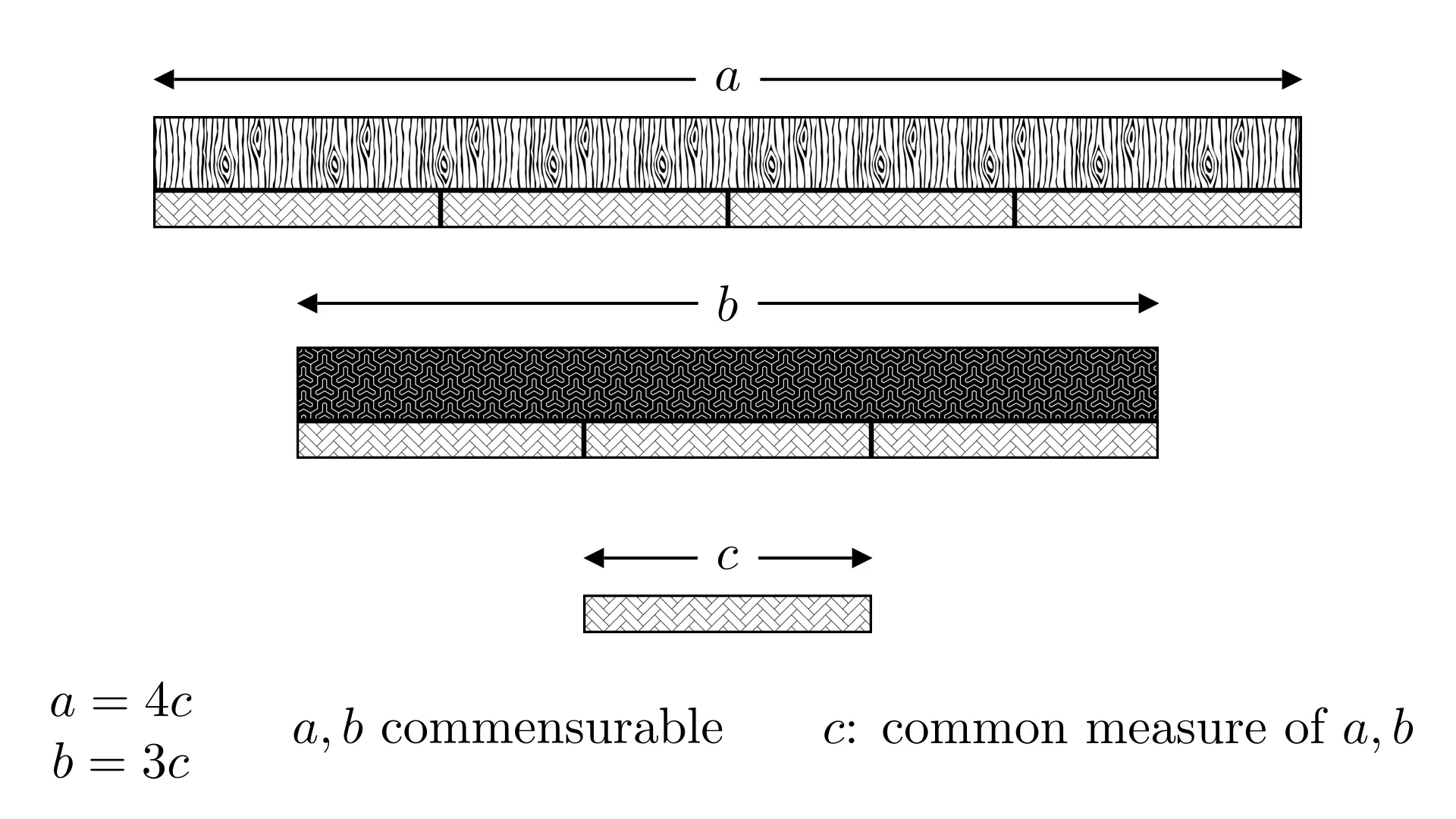
To see this, consider two quantities (say, lengths) a and b, which have a common measure c (and are thus commensurable). This means that c fits perfectly into a an integer number of times, as it does also into b. In more mathematical language, there exist integers n and m such that a equals n times c and b equals m times c. This means that the ratio of the two quantities, a / b, equals n / m, which is a rational number.
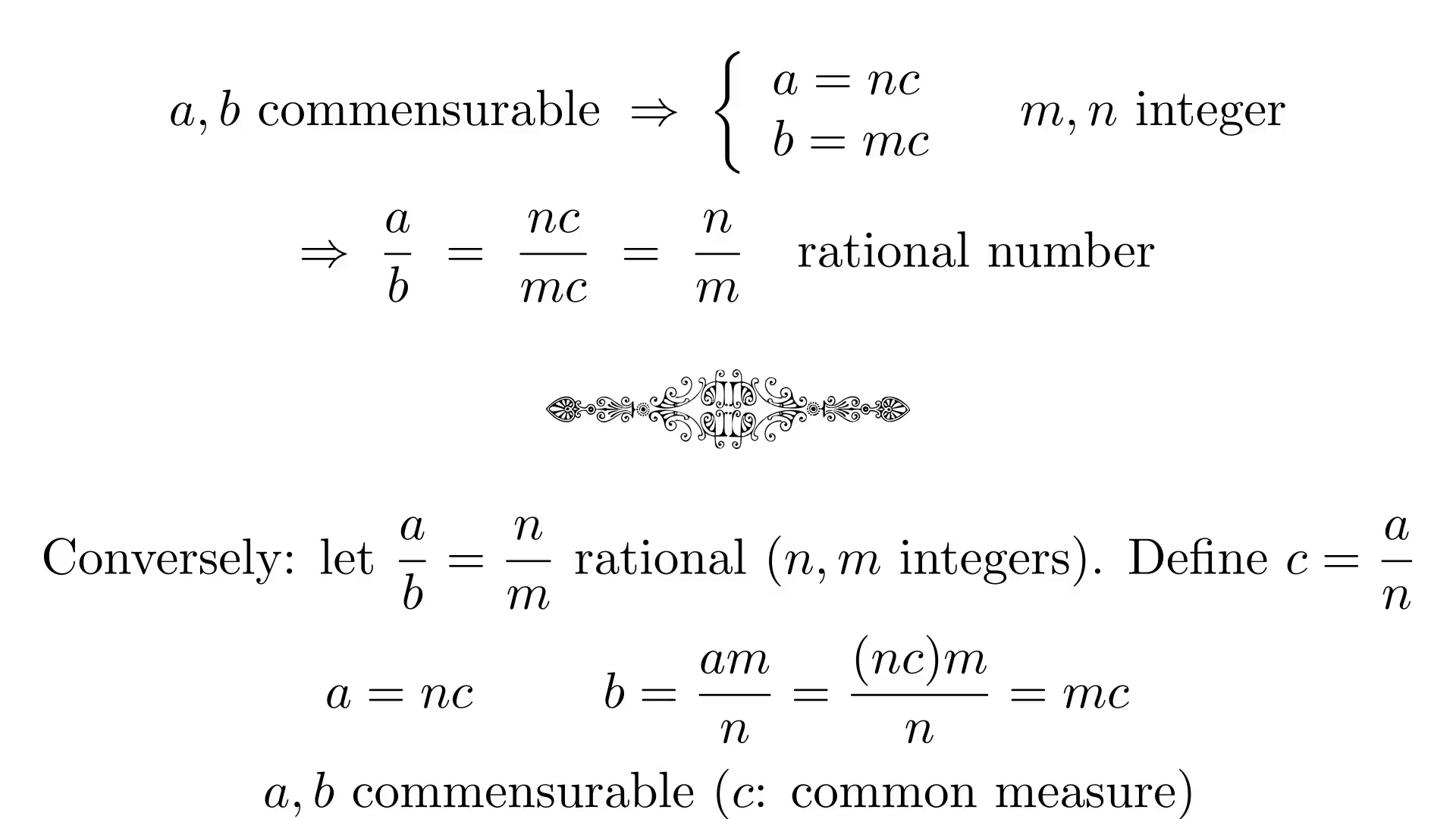
Conversely, suppose that the ratio a/b is a rational number, i.e. a/b = n/m where n and m are integers. Then, consider the quantity c = a/n, which is obtained by splitting a into n equal parts and taking one of them. By definition then, c is a measure of a, as it fits perfectly into it an integer number of times (n times, in particular). But then, by virtue of a/b being equal to n/m, c turns out to be a measure of b as well. Indeed, it turns out that b = mc; c fits perfectly into b an integer number of times, namely m times. This means that a and b are commensurable, with c as a common measure.
Hence the conclusion is that if two quantities are commensurable then their ratio is a rational number and vice versa.
Initially, the Pythagoreans did not suspect that there could be incommensurable quantities. They believed that the properties and essence of things are determined by ratios, or logoi, of natural numbers, like in the case of the musical concords. Knowledge of these logoi or ratios was assumed to give a deeper insight into the true nature of reality, and hence the Pythagoreans were bound to try to discover these fundamental ratios in any phenomenon or perceived object of importance in the world of the senses. As Kurt von Fritz pointed out, "logos" means "word" or "speech" in Greek, but not just any kind of word or speech, but one that conveys significant meaning or insight. This is where the word "logic" comes from. Hence, through the Pythagoreans, "logos" also came to mean ratio, because they thought that these ratios capture the essence of the things in which they are inherent.
The date of the discovery
The discovery of incommensurability was not recorded in contemporary sources. However, there are some clues that enable us to trace it. Firstly, we know that it was made after the time of Pythagoras, since Pythagoras thought that the natures of all things can be expressed through natural numbers. But in Plato's dialogue "Theaetetus" we find also an upper limit for the date of the discovery.
Theaetetus was an Athenian mathematician, a friend of Plato, who also happened to make significant contributions to the field of irrational numbers, recorded in book X of Euclid's "Elements". In the preface of Plato's dialogue, another Euclid, a student of Socrates from Megara, is telling his friend, Terpsion, that he just saw Theaetetus being brought back to Athens from a battle at Corinth in which he was wounded; he apparently later died from his wounds.
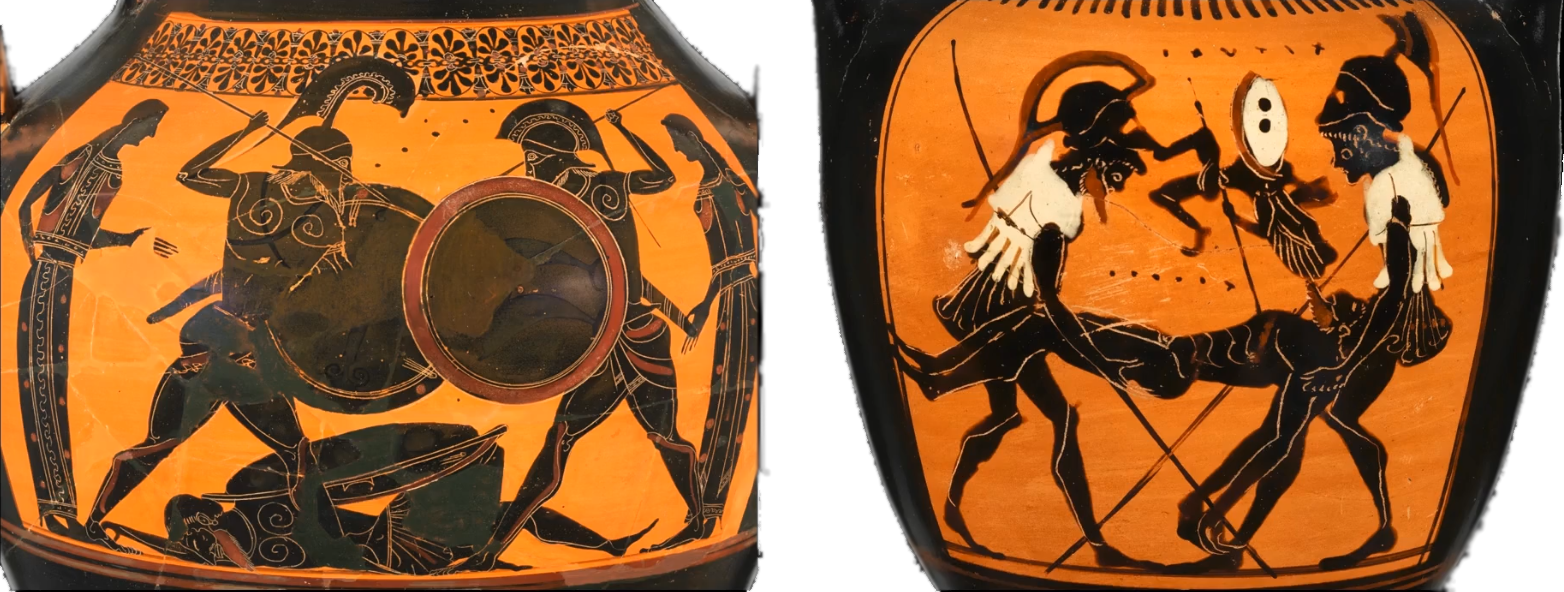
The two men praise the personal qualities of Theaetetus, and Euclid recalls that Socrates had narrated to him a discussion that he had with Theaetetus and the famous mathematician Theodorus of Cyrene (a Greek colony in north Africa, in modern-day Libya). This discussion had taken place not long before Socrates' death, when Theaetetus was a young man of 17 years old, and Theodorus was an old man. Since Socrates died in 399 BC, the discussion cannot have taken place later than that date. The dialogue records Theaetetus as having said to Socrates:
Theodorus here was drawing some figures for us in illustration of roots, showing that squares containing three square feet and five square feet are not commensurable in length with the unit of the foot, and so on, taking them one by one, up to the square containing seventeen square feet – and at that for some reason he stopped. Now it occurred to us, since the number of roots appeared to be infinite, to try to collect them into one group by which we can assign them a name.
Plato, Theaetetus [p. 147e]
What Theaetetus is saying here is that Theodorus was demonstrating to them that the sides of squares with areas of 3, 5, 6, …, 17 square feet (obviously, 9 and 16 are excluded), which equal √3, √5, … √17 feet, respectively, are incommensurable with the length of 1 foot. In other words, he is saying that the ratios √3/1, √5/1 etc. are not rational numbers. In modern mathematical language, we could more simply say that he is saying that √3, √5, … √17 are not rational numbers.
What can this passage tell us about the state of knowledge of ancient Greek mathematics at about 400 BC? On one hand, since Theodorus had to demonstrate the irrationality of the square roots of 3, 5 etc. one by one, this means that a general proof was probably not available – although, Theaetetus and his fellow students could see or somehow infer that there are, in fact, infinitely many such irrational roots. On the other hand, it is striking that Theodorus omitted to mention the most famous irrational root, the square root of 2. This implies that by that time the irrationality of √2 was a well known fact, not worthy of mention in an advanced lesson on incommensurability. Given that at that time there was no internet, and even no typography, and information and knowledge travelled very slowly, this suggests that the discovery of the irrationality of √2 must have been made a long time prior to that discussion taking place.
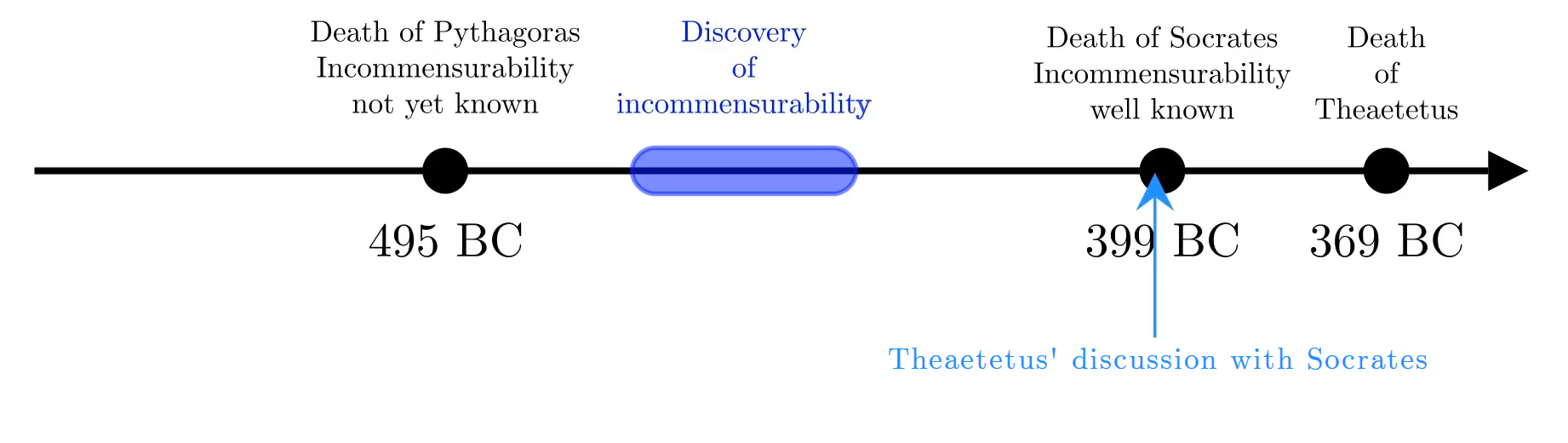
According to ancient tradition preserved by the philosopher of late antiquity Iamblichus (245 – 325 AD), it was Hippasus who discovered incommensurability. Of course, having lived so many centuries later, Iamblichus' testimony is of limited credibility, and in fact the tradition that he preserves does seem to contain legendary elements, such as that Hippasus died by drowning as a divine punishment for making public the secret Pythagorean knowledge. But part of his information seems to originate in the history of Mathematics written by Eudemus of Rhodes, a pupil of Aristotle, who is trustworthy and lived much closer to the time of Hippasus. Unfortunately, though, we are not aware of any contemporary source that directly credits Hippasus with this discovery. Hippasus belonged to the generation preceding that of Theodorus of Cyrene, who was the mathematician demonstrating to Theaetetus and his fellow students the irrationality of the square roots of 3, 5 etc. Therefore, him being the discoverer of incommensurability would fit well with Plato's story. This would mean that incommensurability was discovered in the middle of the 5th century BC.
Some scholars argued for a later date on the basis that Greek mathematics of that time had not yet reached a level of sophistication that would allow such a discovery. For context, that period was the beginning of the Classical period of Greece, with the Persian Wars having ended in mainland Greece a few years prior, marking the end of the Archaic period. But Kurt von Fritz argues, convincingly in my opinion, that neither was Greek mathematics of that era entirely trivial, nor is the level of sophistication needed for discovering incommensurability as great as those other scholars assumed. We can thus attempt, with some speculation, to estimate how this discovery occurred.
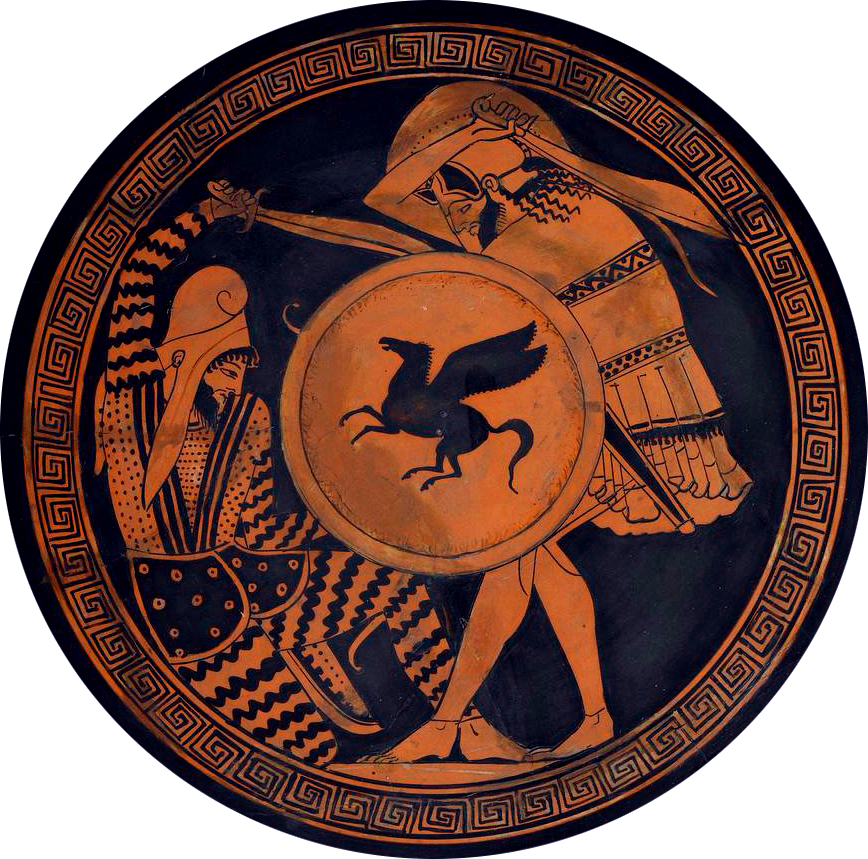
How was the discovery made?
Let us recall Pythagoras' enthusiasm when he realised the truth of the Pythagorean theorem. At that stage, a formal proof was not available, but it was possible to make imprecise measurements that hinted to the truth of the theorem. A special case concerns right triangles with integer sides. That the early Pythagoreans had an interest in such triangles is attested by Proclus, whose reference is probably the credible disciple of Aristotle, Eudemus of Rhodes. According to him, early Pythagorean mathematics produced a formula which allows one to find any number of right triangles with integer sides. That formula is the following identity, which you can verify using simple algebra, where m is any odd integer:
$$ \begin{equation} m^2 \;+\; \left( \frac{m^2-1}{2} \right)^2 \;=\; \left( \frac{m^2+1}{2} \right)^2 \end{equation} $$Using this identity, one can obtain infinitely many triples of integers, called "Pythagorean triples", of the form m, (m2−1)/2, and (m2+1)/2, the sum of the squares of the first two being equal to the square of the third.
Now Proclus, probably using Eudemus as his source, claims that the early Pythagoreans used this formula to discover right triangles with integer sides. But the formula itself has nothing to do with triangles; all it tells us is how to find triples of integers, (a, b, c) say, such that a2 + b2 = c2. It is therefore suggested that the Pythagoreans somehow knew that Pythagorean triples, when interpreted as the lengths of the sides of a triangle, give rise to a right triangle. This is in fact the converse of the Pythagorean theorem. Whereas the Pythagorean theorem tells us that if there is a right triangle with legs of lengths a and b and hypotenuse of length c then a2 + b2 = c2, the converse of the Pythagorean theorem tells us that if a2 + b2 = c2 then we can draw a right triangle with legs and hypotenuse of lengths a, b and c, respectively. The Pythagoreans may have known the truth of the converse Pythagorean theorem empirically, through imprecise drawings, or they may have produced some sort of proof. In case you're interested, here is a video I have made devoted to the converse Pythagorean theorem, where a proof is presented:
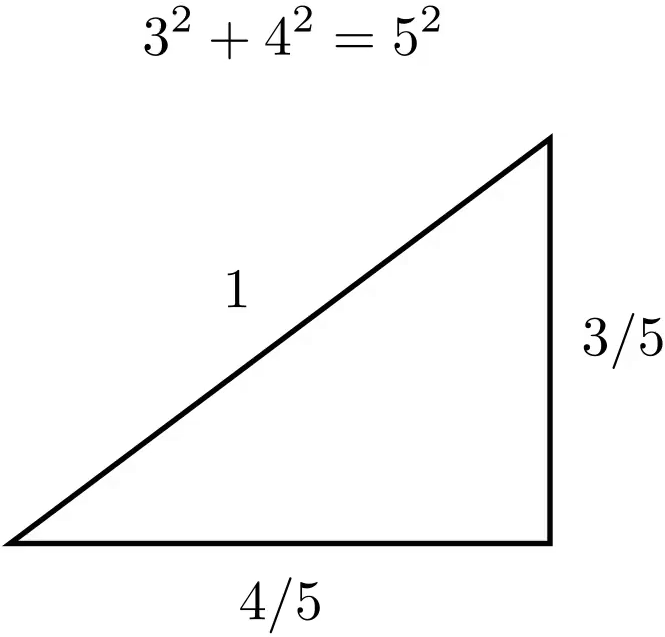
Let us consider the simplest Pythagorean triple, consisting of the numbers 3, 4 and 5, and the corresponding right triangle. Its sides have lengths of 3, 4 and 5 units. But what units is that? Is it centimetres? Feet? Miles? Does it matter? Actually, it does not matter at all. Choosing different units simply scales the triangle up or down, but the proportions of the sides remain the same and hence the geometry is preserved and the triangle remains a right triangle.
To emphasise this, let us choose the length of the hypotenuse as the unit. In other words, let us make lengths non-dimensional, by dividing them by the length of 5 units - whatever they may be - of the hypotenuse. We thus obtain a dimensionless master triangle to which all such dimensional triangles are similar. Whatever relation, therefore, holds for the master triangle, holds for all of them. So, as we can see in the figure below, in all of these triangles the perpendicular sides are 3/5 (three fifths) and 4/5 (four fifths) of the hypotenuse, respectively. According to the Pythagorean belief that everything in nature is governed by integer ratios, this observation, and the fact that the right triangle is a special kind of triangle, adds to the significance of the ratios 3/5 and 4/5. They seem to be "more special" now that we know that they govern the proportions of a type of right triangle. Their status in the mystical hierarchy of numerical ratios that underlies the universe is upgraded.
But this particular right triangle, important though it may have been to the Pythagoreans, as all right triangles, is not the most fundamental one. The most basic right triangle is the isosceles right triangle. Surely then, the ratio that underlies the relationship of the leg to the hypotenuse of that triangle is even more fundamental. But what is that ratio, that logos? Given the interest of the Pythagoreans in right triangles, and that they most likely regarded the isosceles one as a mathematical object of mystical significance, it seems almost certain that they attempted to find out. But the isosceles right triangle eludes their formula (1) for the generation of Pythagorean triples. There is no integer for which the lengths of the two legs in that formula are equal. Therefore, a deeper investigation was needed.
If we assume that the leg-to-hypotenuse ratio is equal to m/n, where m and n are integers, and assuming that the Pythagorean theorem holds for this triangle as well (a fact that the Pythagoreans may not have known for sure but likely suspected), then we arrive at a required relationship between these two integers:
$$ \begin{equation} n^2 = 2m^2 \end{equation} $$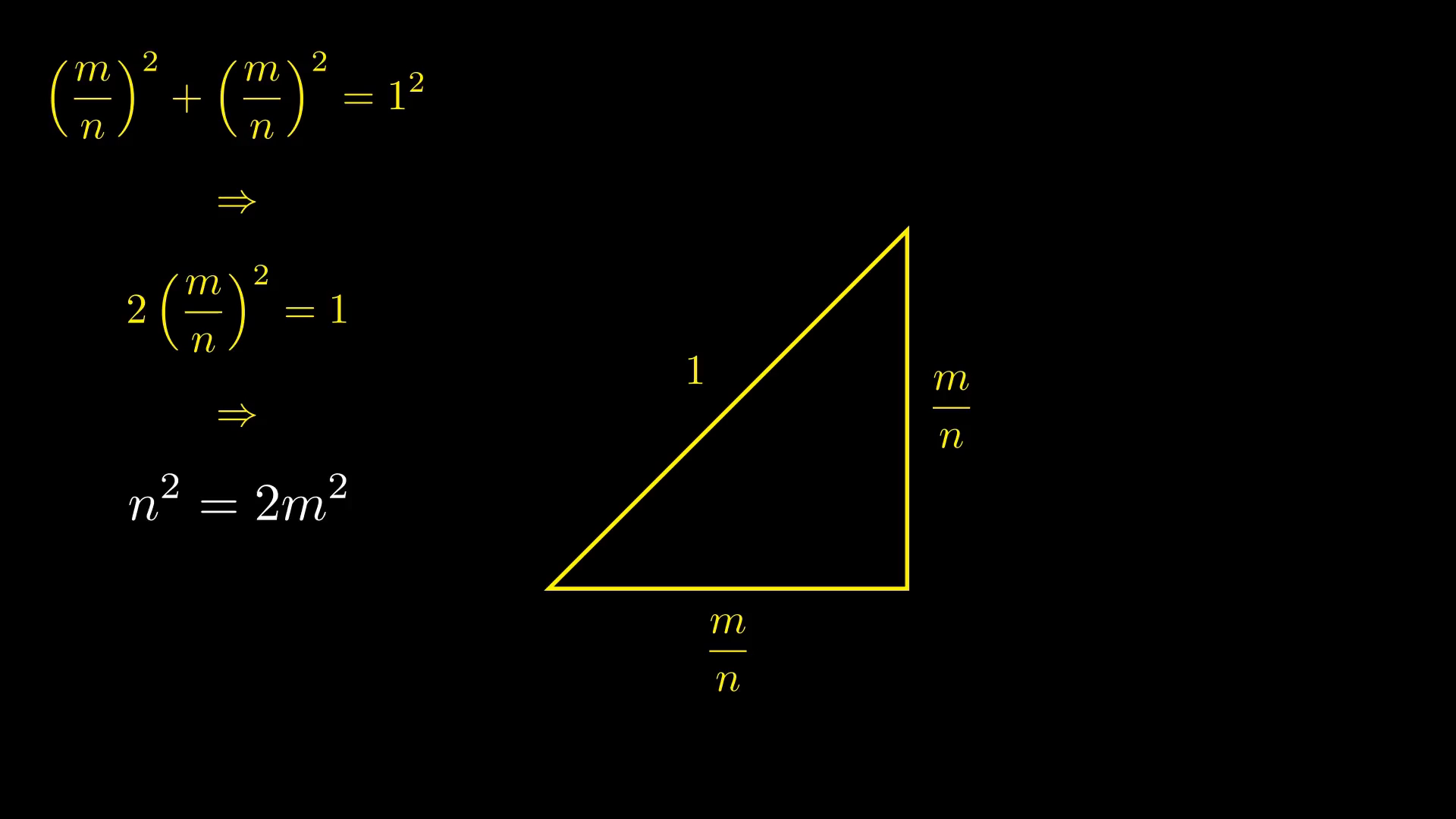
Therefore, the task becomes that of finding two integers that satisfy this relation. It turns out, however, that no two such integers exist; the equation is impossible to satisfy with integers. What does this mean? It means that the proportion between the leg and the hypotenuse of an isosceles right triangle is not equal to any integer ratio. In fact it equals what in modern mathematical language is the reciprocal of √2, which is an irrational number.
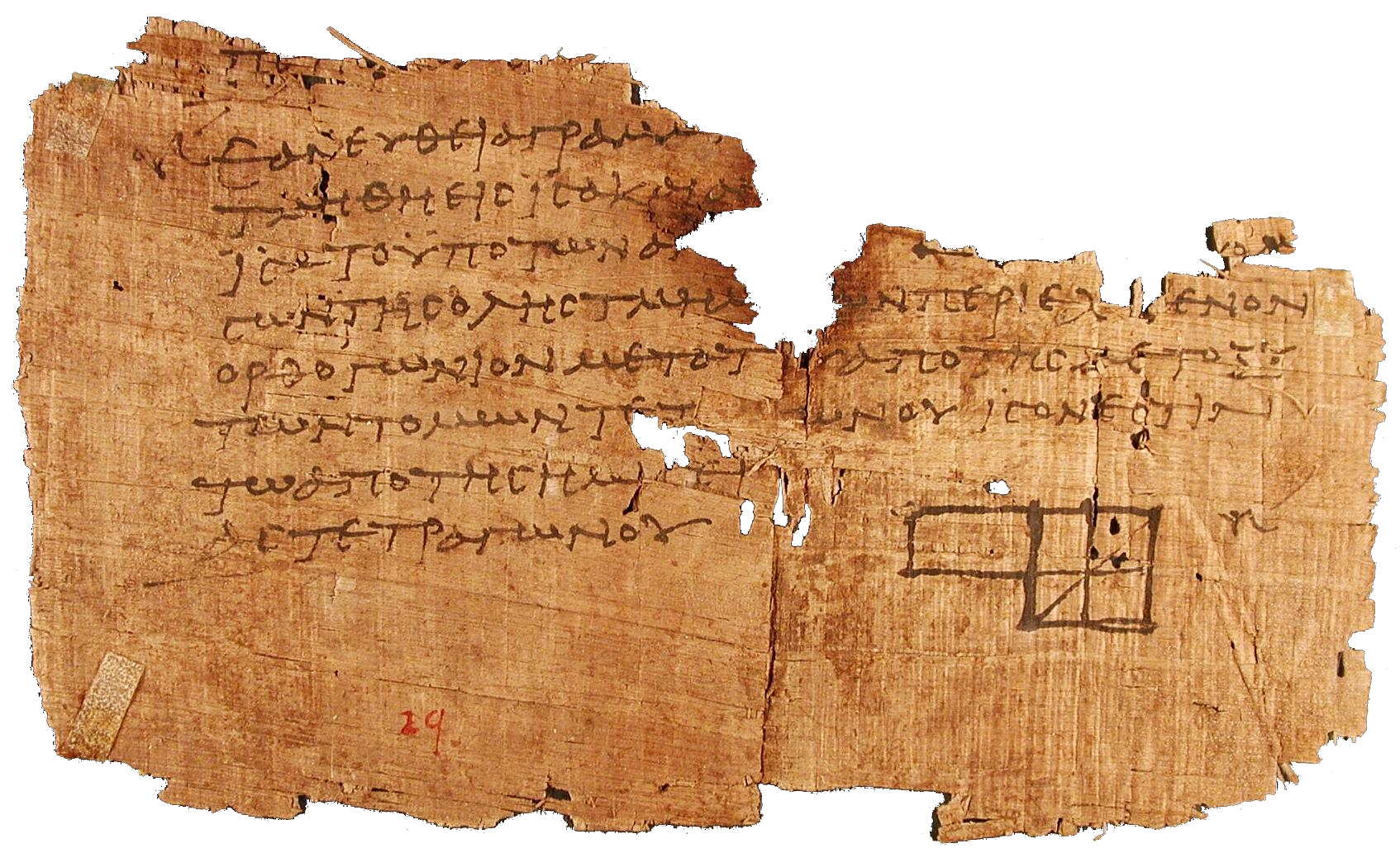
How do we know that no integers m,n exist that satisfy n2 = 2m2? To see it we can follow Euclid, who, in an appendix of the 10th book of his work titled "Elements", presents the earliest known proof that the √2 is irrational. (Alternative proofs can be found in my post on irrational numbers). It is a proof by contradiction, whereby one begins by assuming that the sought integers exist, and arrives at an absurd conclusion. We begin by noting that since
$$ \begin{equation} n^2 = 2m^2 \quad \Leftrightarrow \quad \left( \frac{n}{m} \right)^2 = 2 \end{equation} $$if n and m have any common factors we can cancel them out and the remaining parts, n' and m' say, which are integers that no longer have common factors, must still satisfy the same equation, n'2 = 2m'2. Hence we need only concern ourselves with finding integers n and m that have no common factors and satisfy n2 = 2m2.
Now, since the right-hand side of this equation, 2m2, is an even integer (because of the factor 2), the left-hand side, n2, is also even, and this can only be true if n is even, since the squares of odd integers are odd. So, let n = 2p for some integer p, and substitute this in our equation (2) to get
$$ (2p)^2 = 2m^2 \; \Rightarrow \; 4p^2 = 2m^2 \; \Rightarrow \; m^2 = 2p^2 $$But this is of exactly the same form as our original equation (2), and it similarly implies that m is even! But then both integers, n and m, are even, which makes it impossible that they have no common factor, contrary to our initial assumption, since they are both divisible by 2. We have therefore reached a contradiction. Hence, it is impossible to find relatively prime integers n and m such that our equation (2) is satisfied.
This means that the length of the leg of an isosceles right triangle is no rational fraction of the length of the hypotenuse; their ratio, or logos, is not equal to a ratio of integers. Therefore, the leg and the hypotenuse are incommensurable. Given the interest of the Pythagoreans in odd and even integers, this proof seems quite within their reach. So, this is a likely path that may have led the Pythagoreans to the discovery that not all proportions, or logoi, can be expressed as ratios of integers, i.e. to the discovery that an attribute exhibited by our reality is incommensurability.
However, some modern scholars raised an objection: this path passes through the Pythagorean theorem, which was unlikely to be known in the days of the early Pythagoreans. Euclid's elements, which contains both a proof of the Pythagorean theorem and a proof of the irrationality of √2, were written at about 300 BC, two centuries after the time of Pythagoras, and more than 150 years after Hippasus is stipulated to have discovered incommensurability – although, the proof of the irrationality of √2 is also hinted at, and assumed to be widely known, by Aristotle in his "Prior Analytics" written at about 350 BC. Hence, those modern scholars proposed a later date for the discovery, perhaps in the 4th century.
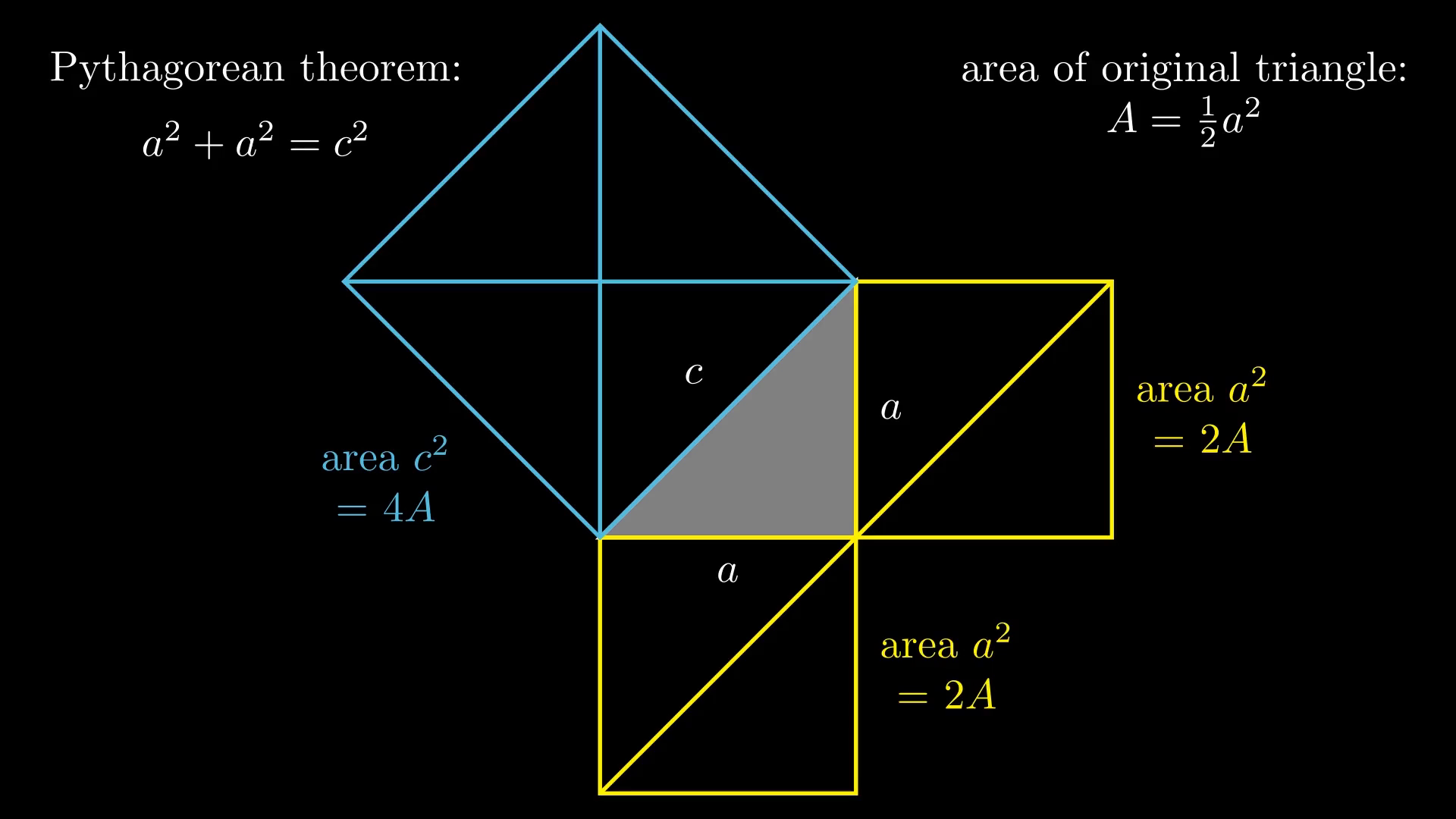
But, as von Fritz noted, this objection is weak because only a limited version of the Pythagorean theorem was needed, applicable to the special case of an isosceles triangle, the truth of which is almost immediately obvious by inspection when one draws such a triangle and the squares of its sides. In the figure below the shaded triangle is an isosceles right triangle with legs a and hypotenuse c, and we can see that the squares of the legs can each be divided into two triangles congruent to the original triangle, while the square of the hypotenuse can be split into 4 such triangles. We know that all of these triangles are congruent because they are all isosceli and right, and for each pair of them we can match the lengths of their legs or their hypotenuses. Therefore, the Pythagorean theorem for this special case obviously holds: the sum of the squares of the legs (2+2 = 4 triangles) is equal to the square of the hypotenuse (4 triangles). This is not a sophisticated result and the early Pythagoreans would have had no trouble figuring it out.
An alternative path
Although it is quite likely that this was the path that led to the discovery of incommensurability, von Fritz suggested another possible path, and his suggestion is quite interesting. It has to do with the method of mutual subtraction, and with an investigation of the properties of the regular pentagon. According to ancient tradition, Hippasus was interested in the properties of the dodecahedron, and by extension to those of the pentagon which is the shape of the dodecahedron's faces. Furthermore, the pentagram, which is formed by extending the edges of a pentagon to the point of intersection, was used by the Pythagoreans as a token of mutual recognition, and as a symbol of well-being and of good deeds.
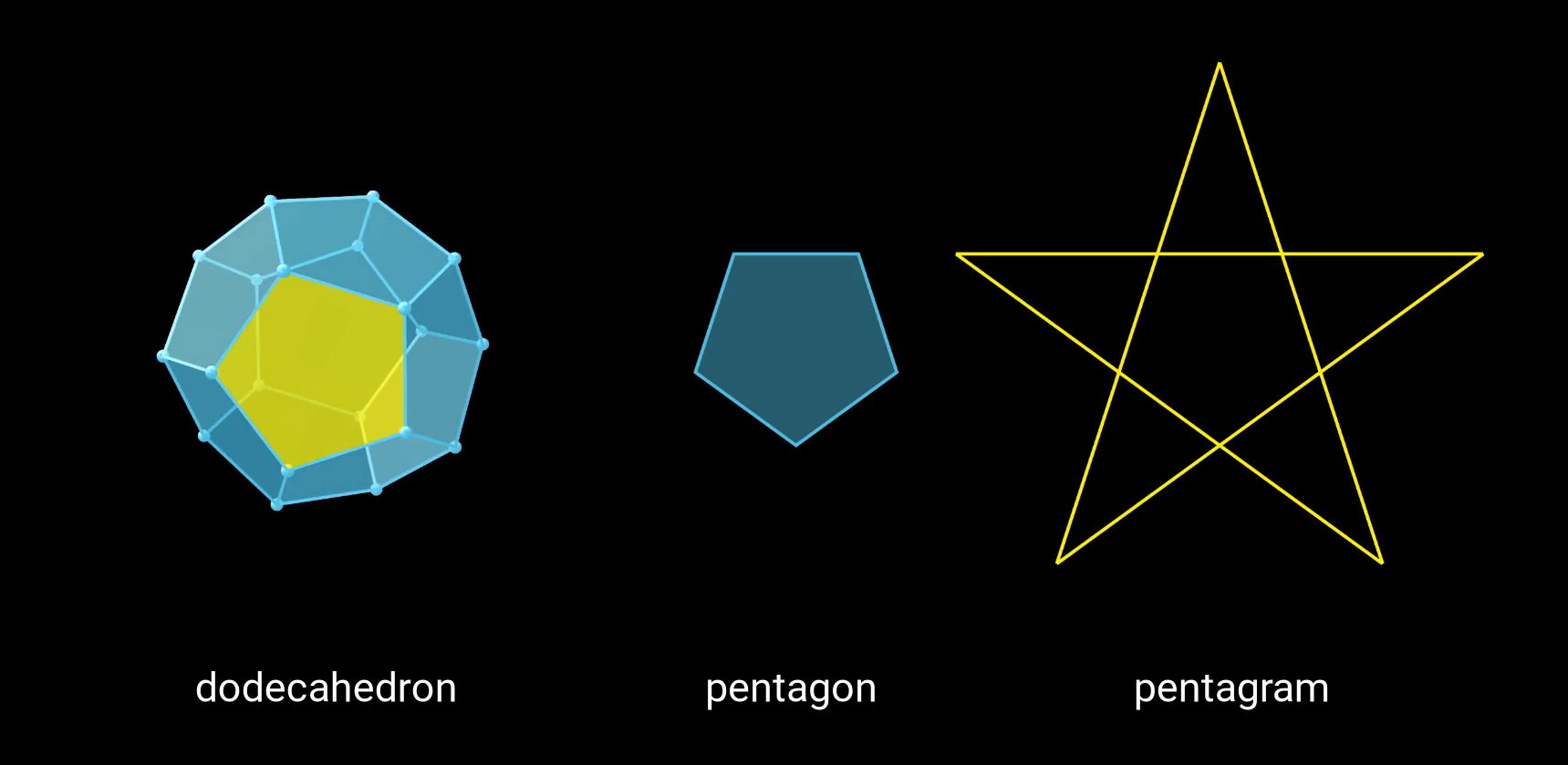
How could the pentagon have been the starting point for the discovery of incommensurability? Well, firstly, being a geometric shape of outstanding significance, the Pythagoreans must have thought that the ratio of its side to its diagonal must be a special logos, just like for the ratio of the leg to the hypotenuse of an isosceles right triangle, and they must have felt compelled to discover what this ratio is.
The standard method used for finding a common measure of two lengths was the method of mutual subtraction, known by craftsmen as a rule of thump long before the time of Pythagoras. For example, suppose that you must cover a rectangular area by square tiles. What size should the tiles be in order to fit perfectly into the rectangle? The side of the tile should fit an integer number of times into both the length and the height of the rectangle. In other words, the size of the tile should be a common measure of both sides of the rectangle. The method of mutual subtraction can be used to solve this problem and find an appropriate tile size. It is the basis for Euclid's algorithm for finding the greatest common divisor of two integers.
The gist is the observation that if the tile side a is a common measure of both the length L and height H of the rectangle then it is also a measure of their difference L−H. Indeed, suppose that a is a common measure of L and H. Then L and H are multiples of a, but it turns out that so is their difference:
$$ \begin{equation} \left. \begin{array}{l} L \;=\; m \, a \\ H \;=\; n \, a \end{array} \right\} \;\Rightarrow\; L-H \;=\; (m-n) \, a \end{equation} $$In the above expressions, m and n are integers since a divides both L and H, and therefore m−n is also an integer, and hence a divides also L−H. In other words, any common measure of two lengths is also a common measure of their difference. How does this help us? Well, instead of trying to find the greatest common measure of the sides of the rectangle, we can try to find the greatest common measure of the smallest side and the difference between the two sides, as this would be guaranteed to be also a common measure of the other side. Indeed, if a is a common measure of H and of L−H, then it is also a common measure of L:
$$ \begin{equation} \left. \begin{array}{l} H \;=\; j \, a \\ L-H \;=\; k \, a \end{array} \right\} \;\Rightarrow\; L \;=\; (j+k) \, a \end{equation} $$Thus the problem is reduced to finding the common measure of a pair of lengths that are smaller than the original pair.
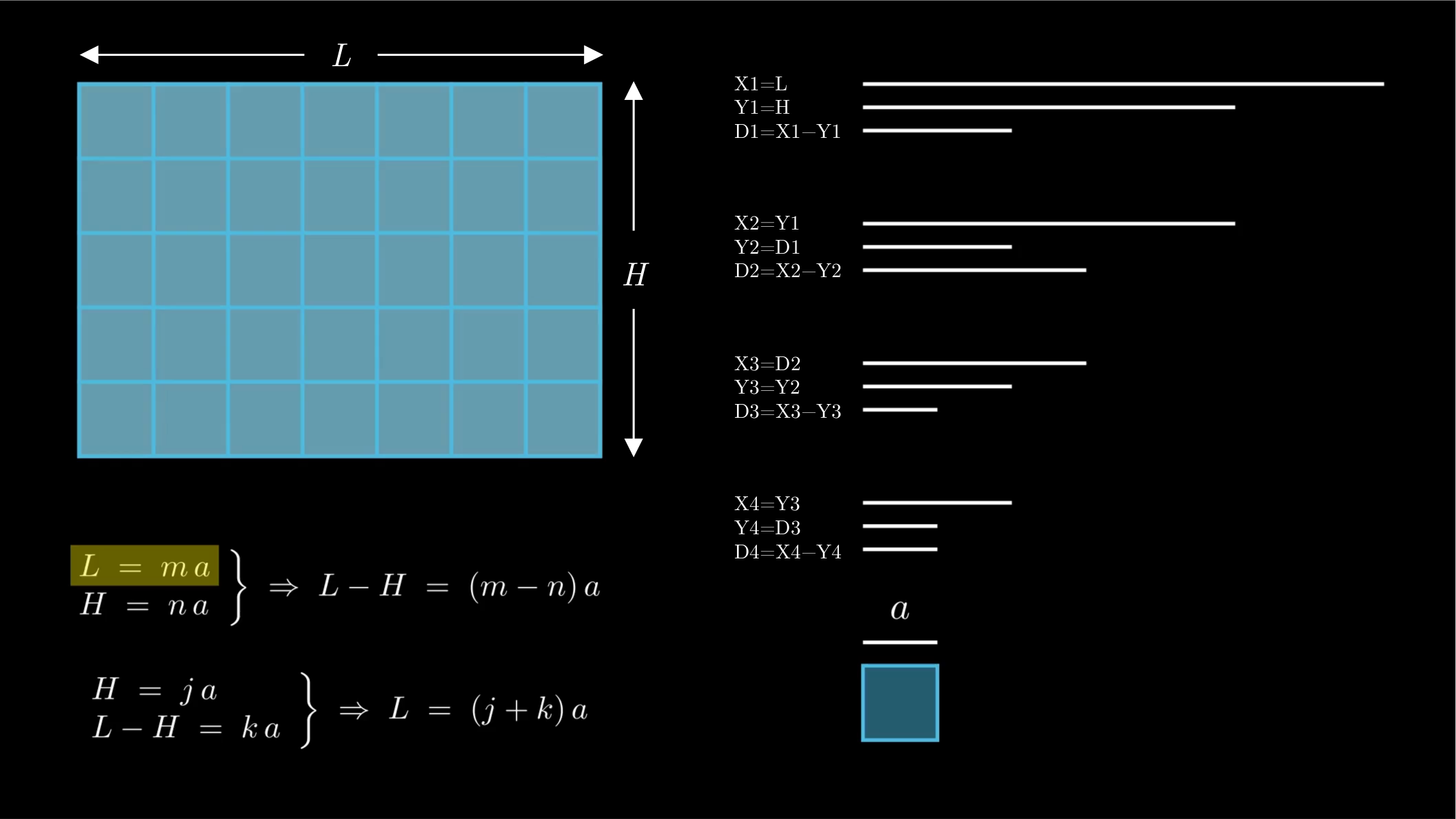
Let us apply this to a practical example. The rectangle above has sides L and H. Since L > H, we measure their difference L−H, and this completes the 1st step. Now we have three lengths: the two sides, and their difference. We pick the two smallest, and repeat the same procedure: compare the lengths, and take their difference as a third length. Again, we take the two smallest of the three, and repeat. The sequence of steps is depicted on the right side of the above figure, where at step i the lengths Xi and Yi are compared, their difference is measured, and the two smallest of Xi, Yi, and Xi−Yi are carried on to the next step.
At the end of the fourth step, the two smallest lengths we end up with are equal. Hence, in the fifth step, their difference would be zero, and the algorithm could not proceed further. But notice that, due to the equations shown at the bottom left, the two lengths Xi and Yi of all steps have exactly the same common measures. In going from one step to the next one, or to the previous one, no common measures are introduced or removed. In the last step, where the two lengths X5=Y5=a are equal, this common measure is obvious: it is this common length a. But then, this length is a common measure of all lengths encountered in all previous steps, including the sides of the rectangle that we started with. We can thus choose it as the size of our square tiles.
Notice that, since the common measures of the first step are exactly the same as those of the last step, there cannot be any common measure larger than the length we ended up with on the last step. In particular, the length arrived at by our procedure is the largest common measure of the original lengths. And all other, smaller, common measures are integer subdivisions of the largest common measure. Thus, by splitting the latter into two, three, etc. equal parts, we can make smaller tiles, or even non-square tiles (if we choose different common measures as their sides).
Is this procedure guaranteed to produce the greatest common measure of two lengths in a finite number of steps? The answer is yes, provided that the two lengths do have a common measure. To see this, suppose that they do, and let us denote it by a. Notice that at each step of the mutual subtraction algorithm the subtraction reduces the larger of the two lengths by a multiple of a (in particular, it reduces it by the smaller of the two lengths, which is a multiple of a). Since each step of our procedure causes a reduction of the lengths by at least a, the lengths are bound to reduce to zero in a finite number of steps – at most m steps, where m is the integer appearing in the equation L=ma highlighted in the figure above.
In Euclid's algorithm for finding the greatest common divisor of two integer numbers, we know that they at least have the number 1 as a common measure, since they are both integers, and therefore the algorithm is bound to return a result in a finite number of steps. But if the two quantities are arbitrary, is the algorithm bound to finish in a finite number of steps? Well, if all quantities in the universe have some common measure, as the early Pythagoreans believed, then yes, the algorithm is bound to finish in a finite number of steps, as we just explained. But what if it turns out that this algorithm, for some pair of quantities does not finish in a finite number of steps? Well, necessarily, this would mean that these quantities have no common measure, and the early Pythagoreans were wrong after all.
Now, let us consider the likely scenario that Hippasus, when studying the properties of the regular pentagon, decided to try to determine the ratio of the pentagon's diagonal to its side, believing it to be some important logos. He would have used the method of mutual subtraction to determine this logos. Let us see where this path would have led him.
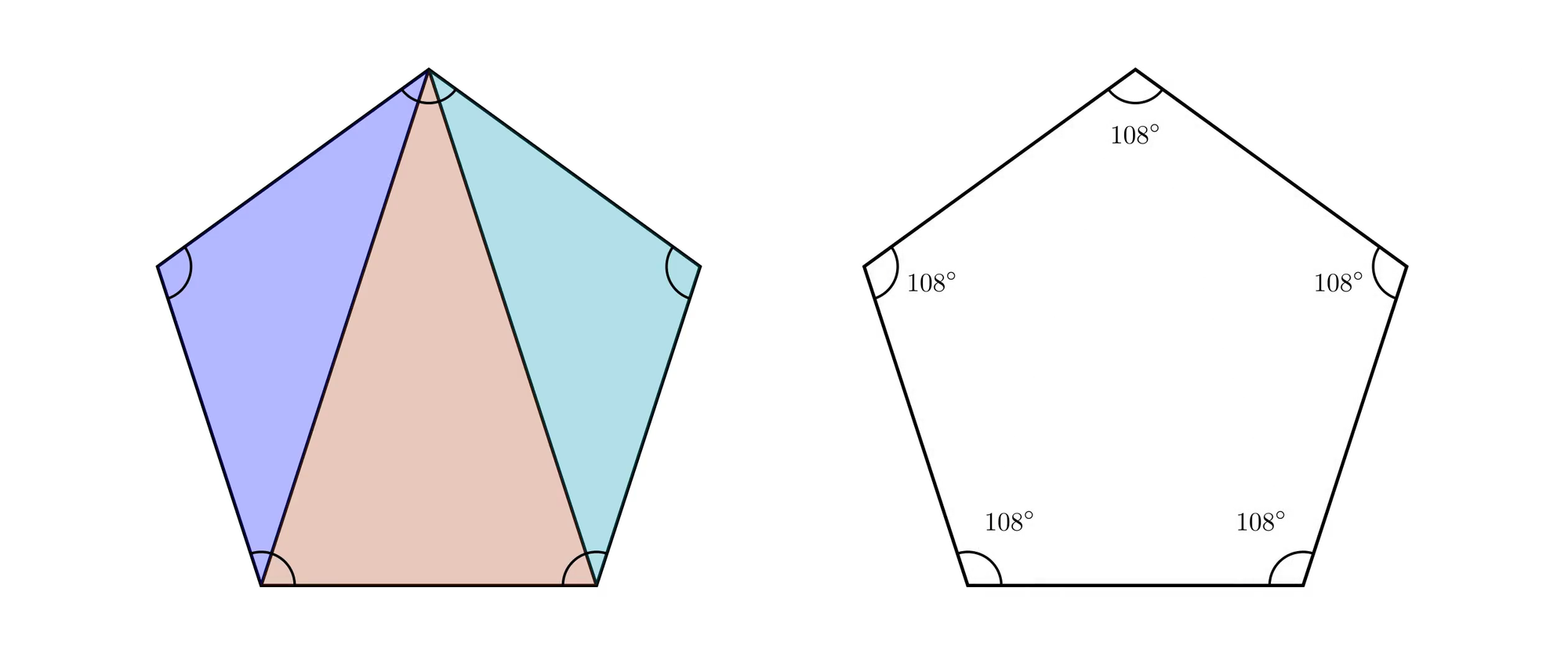
First, let us draw two diagonals from the same vertex, to divide the pentagon into three triangles. The angles of each triangle sum to 180 degrees, hence the angles of all the triangles summed together, which equal the sum of all interior angles of the pentagon, is equal to 3*180 = 540 degrees. Hence, each of the 5 internal angles of the pentagon equals 540 divided by 5, or 108 degrees.
Now let us draw all the diagonals of the pentagon, with two emanating from each vertex. This splits each internal angle into one angle denoted a, between the diagonals, and two angles denoted β, on either side.The diagonals form a pentagram, and in the middle of the figure we can see, highlighted, another pentagon. We know that it is a regular pentagon because, due to symmetry, all its angles and all its sides are equal. Therefore, we know that its internal angles equal 108 degrees each. From this we can deduce that the base angles of the isosceles triangle AD'C' equal 72 degrees and hence the remaining angle a equals 36 degrees (a = 180°–72°–72° = 36°).
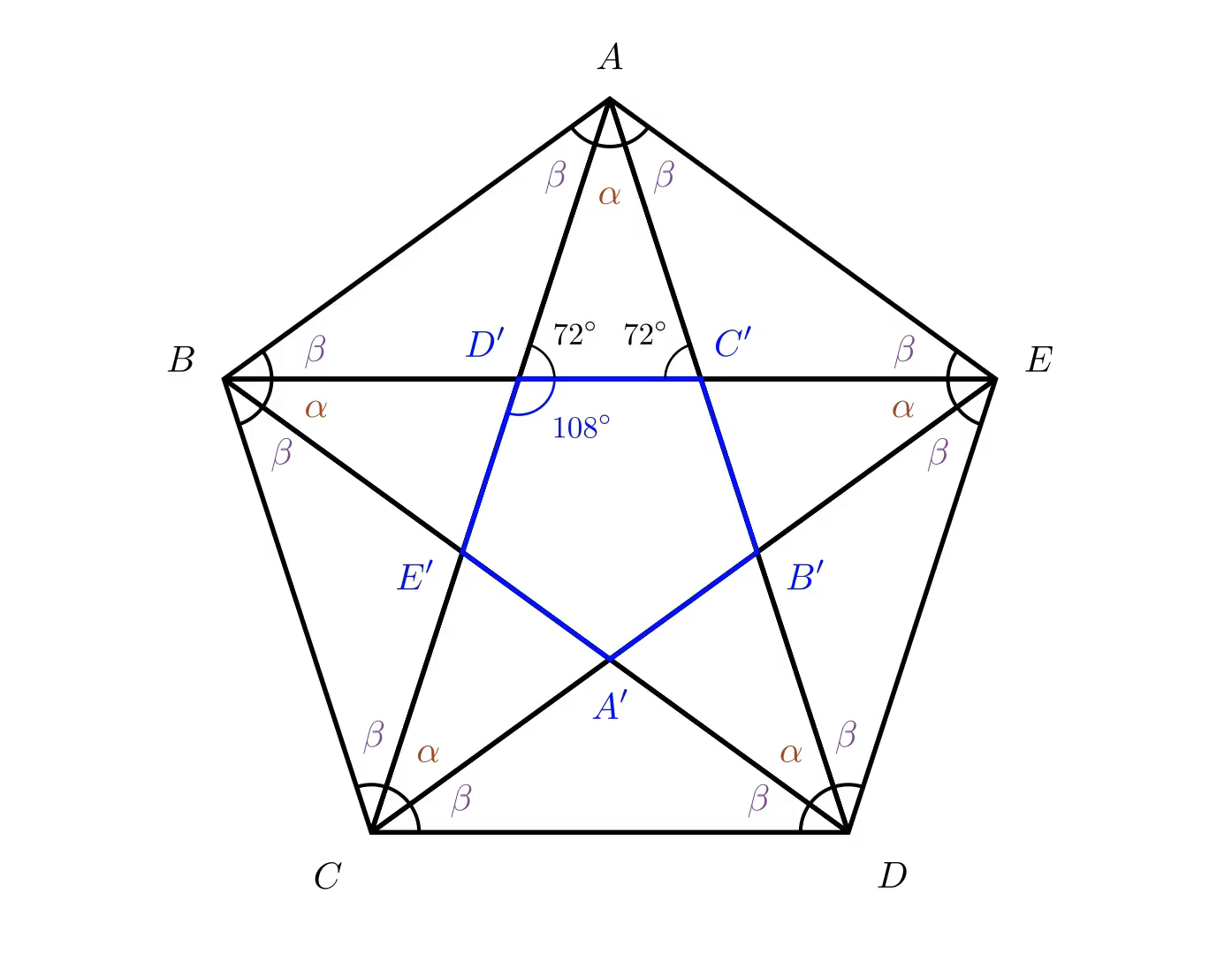
To determine the angle β, let us consider the internal angle A, at the top of our pentagon. Since it equals 108°, and it also equals 2×β+α, where α=36°, it turns out that β also equals 36°. The two angles happen to be equal. So, to simplify things, let us get rid of β and label all angles as α. In radians, α is equal to a fifth of the straight angle π. Each internal angle of the pentagon equals 3α = 3π/5.
With this knowledge, let us begin the mutual subtraction process to determine the largest common measure of the side AB and the diagonal AC of the pentagon. As per the algorithm, we begin by subtracting these two lengths.
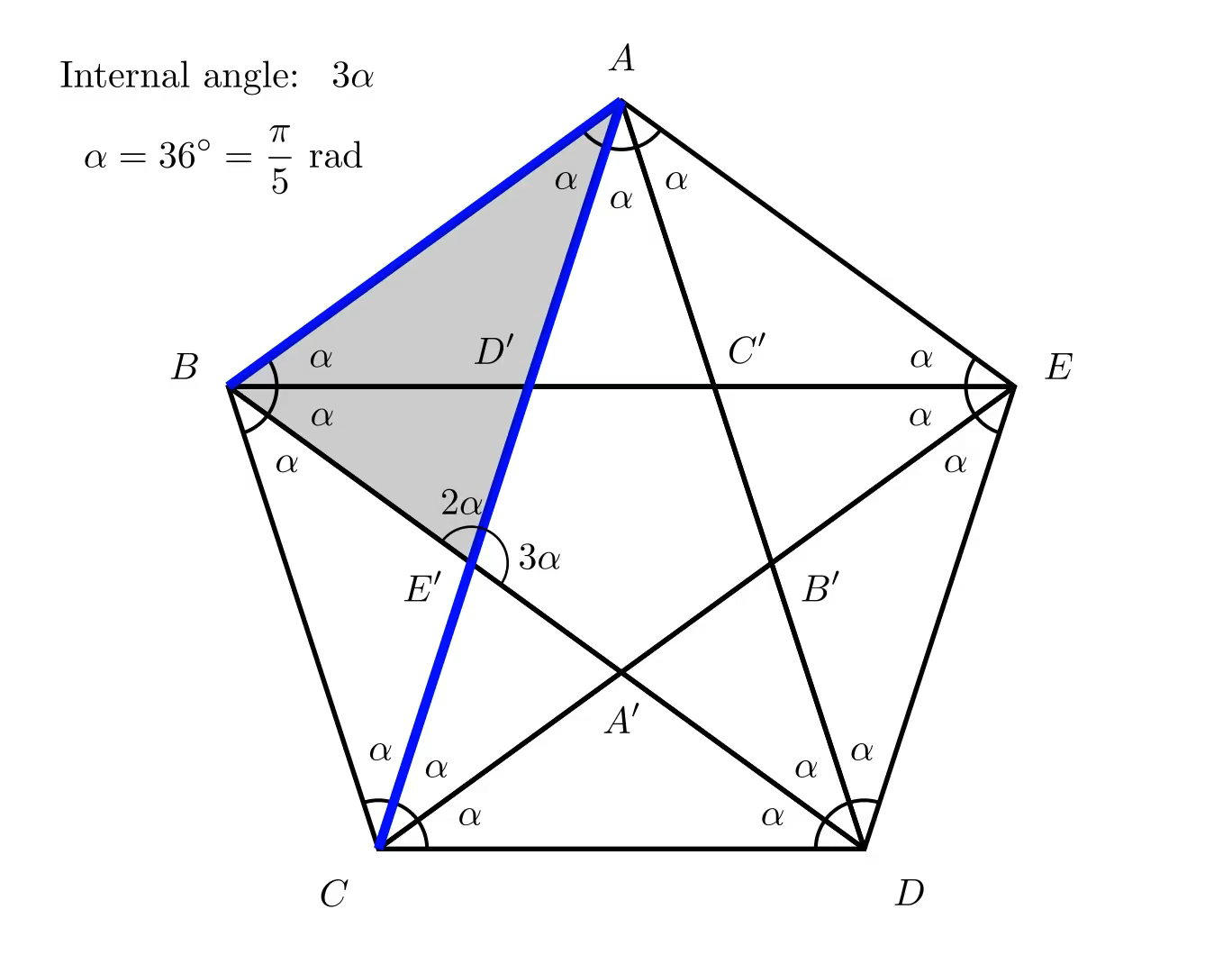
But first, consider the triangle ABE' and notice that it is isosceles because the angles at its base BE' are equal. Hence AB equals AE', which is easier to subtract from AC as they lie on the same line. Their difference is CE'. But due to symmetry this is also equal to AD'.
- To summarise the first step of the algorithm, we begun with the lengths AC and AB and formed their difference AC−AB = AD'.
- In the second step, we take the two smallest of the three lengths involved in the first step, i.e. AB=AE' and AC−AB=AD' and subtract them: AE'−AD' = D'E'.
In the third step, we again take the two smallest lengths of the 2nd step, AD' and D'E', and subtract them. But pause for a moment and compare the triangles EAD' and EA'D'. The former, EAD', is congruent to ABE' that we saw previously to be isosceles. The latter, EA'D', due to symmetry, has its two sides ED' and EA' equal, and is hence also isosceles and in fact congruent to EAD' as they share a leg. Therefore, the two lengths AD' and A'D' are equal, and we can replace the former with the latter in our algorithm.
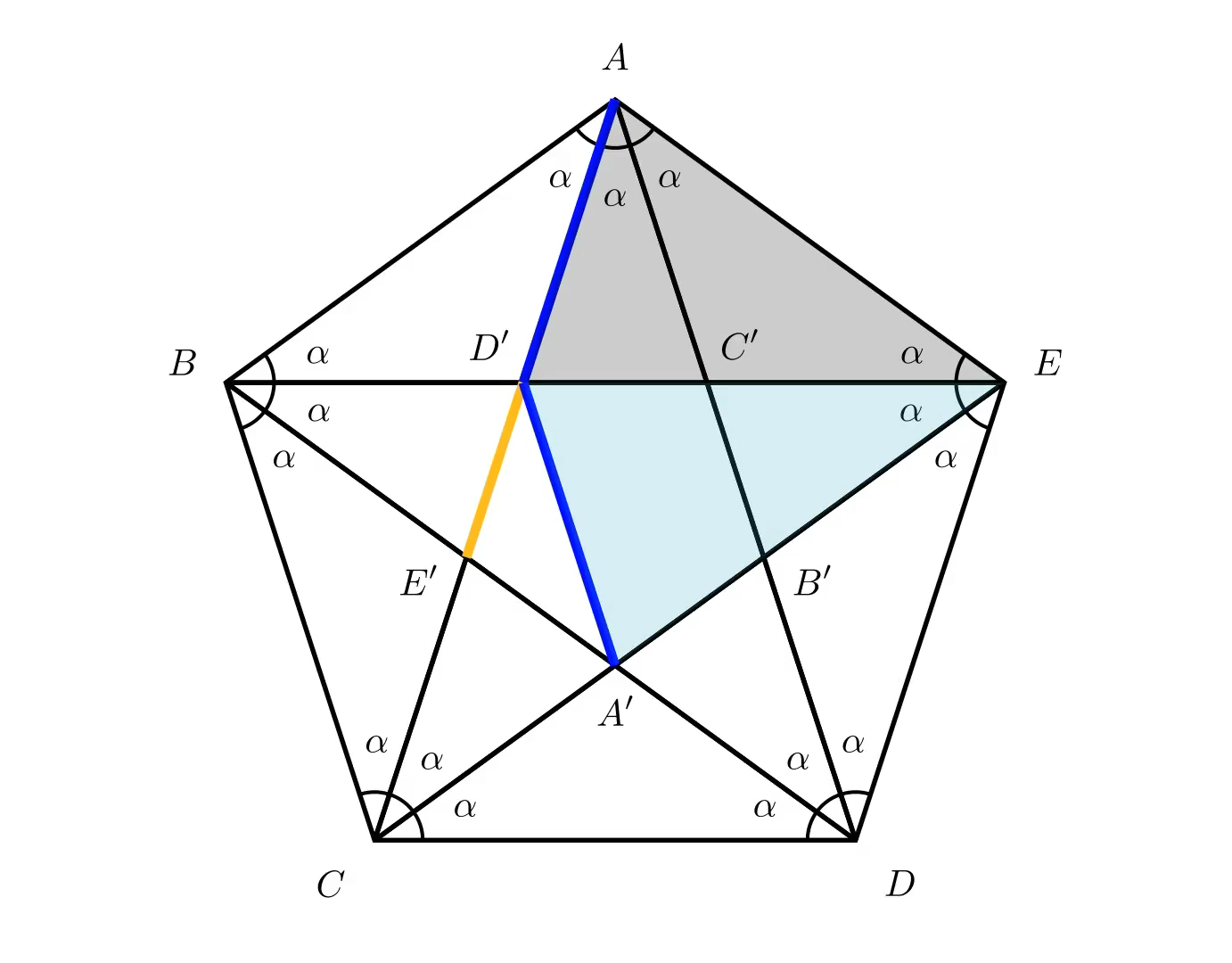
- To summarise the third step, we took the lengths AD'=D'A and D'E' and subtracted them.
But what do we notice now? We notice that we ended up right where we first begun. The lengths D'E' and D'A' that we subtract in step 3 are the side and the diagonal of the smaller pentagon A'B'C'D'E', whereas the algorithm begun by subtracting the side AB and the diagonal AC of the large pentagon ABCDE. We have therefore entered a vicious circle, for it is obvious that step 5 will be about finding the common measure of the side and the diagonal of an even smaller pentagon, and step 7 of a pentagon smaller still, and so on to infinity. The mutual subtraction algorithm will therefore never terminate, which, as we saw, means that the side and the diagonal of the pentagon have no common measure.
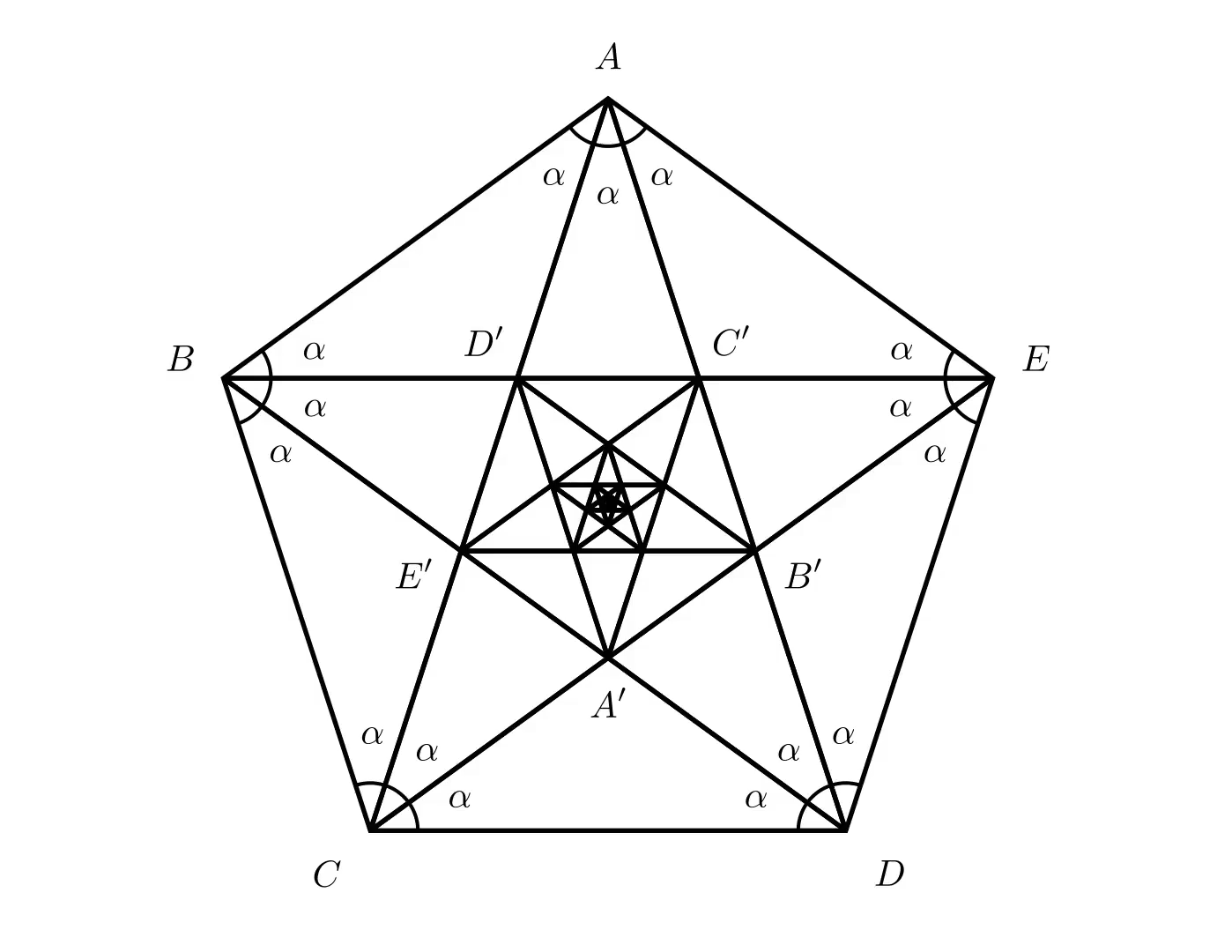
The mathematics involved are not sophisticated and were certainly within the reach of the early Pythagoreans. So, this is indeed a possible path that may have led them, or Hippasus in particular, to the surprising discovery of incommensurability.
Conclusion
This discovery shattered the Pythagoreans' profound belief that at the core of reality lie integer numbers, with the workings of the universe governed by their ratios. Nowadays, we learn about irrational numbers, i.e. about proportions not expressible as ratios of integers, early in our school education and hence they are taken for granted and their mystery is overlooked. But in the days of the Pythagoreans, when philosophers were like children discovering the world, this discovery made a deep impression. It is perhaps useful for us too to take a second look at things that we unconsciously take for granted, and re-discover the beauty and mystery of reality, like children.